June is National Indigenous History Month, a time to recognize and celebrate the rich cultures, histories, and contributions of First Nations, Inuit, and Métis Peoples across Canada, from coast to coast to coast.
This month is also an opportunity to reflect, learn, and recommit to reconciliation and the advancement of Indigenous rights. Meaningful reconciliation begins with awareness and action, and each of us has a role to play.
One way to take action this June is to deepen your understanding of Indigenous histories, rights, and realities. PSAC’s online course, Walking in Our Truth Together, was developed in collaboration with Canadian Geographic and invites you to explore treaties, Indigenous law, residential schools, MMIWG, and more, at your own pace.
We also encourage everyone to explore resources from the National Centre for Truth and Reconciliation and consider making a personal or professional commitment aligned with the TRC’s Calls to Action.
Resolutions are one of the main ways members bring issues forward and propose changes, improvements, or new directions at UNE Convention.
If you want the union to act on an issue that matters to you — a resolution is how you make it happen.
What Is a Resolution? A resolution is a short and structured proposal that identifies an issue or concern, explains why that issue matters to members, and proposes a clear action for the union to take in response.
How to Write a Strong Resolution
The most effective resolutions are clear, focusing on one issue at a time; action‑oriented, stating exactly what you want the union to do; and concise, keeping the proposal short and to the point.
Most resolutions follow a simple format:
“The Union of National Employees will” — states what action should be taken
“Because” — explains the context or problem
Example:
The Union of National Employees will encourage unions to submit resolutions to convention in a clear language format.
Because the actions proposed will be better understood by convention delegates.
Because clear language is a valuable way to help union members feel included by the labour movement.
Because the clear language format makes sense: we start with what we want, then we back it up with our reasons.
Typically, the process begins at the Local level, where you bring your idea to a meeting, discuss and refine it with fellow members, and then participate in a vote to decide whether the Local will submit the resolution to Convention.
This helps ensure resolutions reflect the priorities of the membership.
Even a rough idea is a great starting point, so do not limit yourself. Your Local can help you:
Develop your idea
Draft the resolution
Ensure your resolution meets submission requirements
Submitting a Resolution
Resolutions are submitted before the main deadline, allowing time for review by the Pre-Convention Committees (Finance, General, or By-Laws & Policies).
Submitting early ensures your resolution can be fully reviewed and discussed.
For Convention 2026, the deadline to send your resolutions is May 29th, 2026.
Late Resolutions Resolutions received after May 29th, will be considered late resolutions. They will be considered only after all other resolutions have been reviewed and debated, with discussion time often more limited as a result.
Emergency Resolutions Emergency resolutions are introduced during Convention.
They must address issues that:
Could not have been anticipated earlier
Require immediate attention
Because of their nature, they must clearly demonstrate why they meet these criteria.
How to Submit a Resolution
You should submit your resolutions electronically on our website. Completing this process significantly reduces the time required to prepare resolutions for our committees’ review. If you do not have internet access, you can submit your resolutions by mail or fax.
Submit Supporting Documentation
Resolutions submitted online must be supported by signed minutes confirming that the resolution was adopted at a general local meeting.
Scanned copies must be sent to Ateau Zola at resolutions@une-sen.org.
You may also submit supporting documents by mail or fax.
Submission Deadline
Please send your resolution before May 29th, 2026. Any resolution received after this date will be classified as a late resolution and will only be reviewed and debated after all other resolutions, with more limited time for discussion.
Have an idea? Bring it forward.
Resolutions are one of the most powerful ways members shape the future of UNE.
Your voice matters — and Convention is where it’s heard.
Convention is the highest decision‑making body of our union. Every three years, delegates from across the country come together to review our By‑Laws and Policies, debate resolutions, and approve the budget that guides UNE’s work. In a regular cycle, Convention is also when delegates elect the National Executive.
This year, delegates will carry out the same important Convention work. Because UNE is currently placed under Trusteeship, the election for the National Executive may take place at a later date. If that happens, only members who are accredited as delegates for the 2026 Convention will be able to vote — even if the vote occurs on a different day. This Convention is especially important. The decisions we make in August 2026 will help set the foundation for how we rebuild and move forward as a strong, member‑focused union. Your involvement — whether as a delegate, a resolution writer, or an engaged member — truly makes a difference.
Union of National Employees: A Union Like No Other
We represent over 23,000 members working in 73 different workplaces, with as many collective agreements. Our members work in the public sector, the private sector, and the non‑profit sector. They work in every region of this country — and even around the world.
This diversity is one of our greatest strengths. But it also means that democracy is essential to how we function. We need voices from every workplace, every region, and every type of job to help shape the decisions that affect all of us.
That’s why your participation matters so much.
And that’s also why we extended the registration deadline — because not all Locals have sent someone yet, and we don’t want anyone to miss the opportunity to take part in the Convention that represents you.
What Happens at Convention
In August, delegates work together to make decisions that guide UNE for the next three years. They will:
Debate and vote on resolutions submitted by group of members
Approve the budget that sets our priorities and supports our activities
These decisions shape how we support members, how we grow, and how we continue building a strong, inclusive union.
Why Your Resolutions Matter
Resolutions are one of the most important tools members have to influence the direction of UNE.
A resolution is simply an idea or proposal for change. It can be something you want to improve, something you want to add, or something you want the union to do differently.
Every resolution submitted is reviewed by the appropriate Convention Committee before the Convention:
Convention is where we come together to make decisions that shape the future of UNE, and an excellent opportunity to connect with fellow activists and build lasting relationships. Whether you’re attending as a delegate, submitting a resolution, or simply learning more about the process, your involvement strengthens our union.
On May Day, also known as International Workers’ Day, we reflect on what we have won together and on the power of collective action to create change in our workplaces and communities.
We mark May Day to honour the roots of our movement. On this day in 1886, in Chicago, Illinois, workers took to the streets in a general strike to fight for an eight-hour workday. Their protest was met with violence from anti-union forces determined to stop these protections from becoming reality.
But when workers stand together, we are powerful. And when we stay united in the face of backlash, we can win lasting change.
One hundred and forty years later, the eight-hour workday is the standard for many workers, and the labour movement continues to fight to protect these rights and expand them for everyone.
The eight-hour workday is just one example of what workers have won through organizing. Workers are who secured weekends, maternity and parental leave, health and safety laws, employment standards, and so many other protected rights that we benefit from today.
PSAC has a long and proud history of helping raise the bar for workers across the country.
In 1980, over 10,000 PSAC members in clerical and regulatory jobs, positions primarily held by women, organized and took action for equal pay. They won wage increases for themselves and their coworkers and helped spark broader demands for pay equity across the public service.
In 2026, we carry that struggle forward. We are working to protect the public services that make our country strong. We’re fighting for flexible work arrangements. We are pushing back against the misuse of risky AI technologies that threaten good union jobs. And we’re demanding safe and healthy workplaces for all.
Today, we recommit ourselves to the solidarity that anchors our movement. Together, we can create change in our workplaces and strengthen our communities and our country.
We do that by growing our movement and staying united.
Want to join the campaign to protect public services and workers’ rights? Visit ForYouCanada.ca to sign up and take action.
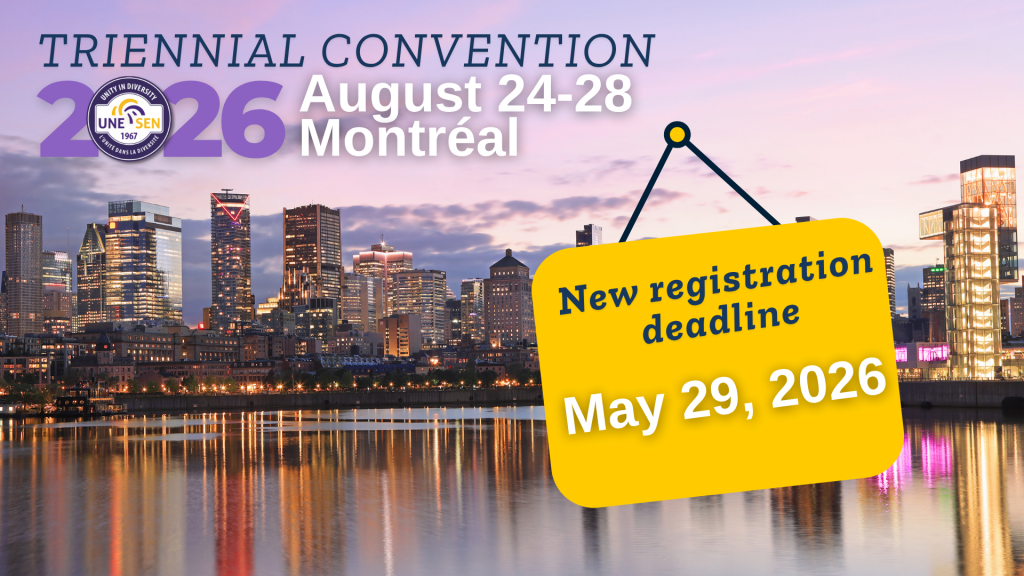
Good news, UNE members. The registration deadline for the 2026 UNE Triennial Convention has been extended.
New registration deadline: May 29, 2026
This extension gives more UNE members the opportunity to vote for their delegates. Delegates will register and take part in the Convention, where important discussions and decisions about the future of our union will take place.
The 2026 PSAC National Young Workers Conference will be held November 7-9, 2026, in Ottawa under the theme Young Workers: Taking Power, Challenging Norms.
PSAC members in good standing who are 35 and under are invited to register. During the conference, delegates will take part in workshops, debate resolutions, and participate in elections. The conference is an opportunity for young workers to continue the important work of building union militancy and activism and strengthening the fight to improve the working conditions of all PSAC members.
Young workers interested in attending the conference as delegates or observers must apply by Friday, May 29, 2026. Selected delegates will be notified by email by September 1, 2026.
This week, UNE delegates from locals in Manitoba and Saskatchewan are gathering in Winnipeg for the 2026 Regional Seminar. Over three days, participants will explore practical tools, share experiences from their workplaces, and strengthen the connections that support effective representation.
The seminar is designed to help delegates build confidence in their roles, deepen their understanding of key issues, and leave with what they need to move forward:
clearer knowledge of their rights and responsibilities
answers to the questions they bring from their locals
new contacts and support networks across the region
a stronger foundation as they prepare for the 2026 Convention
We’re looking forward to a productive and energizing week together in Winnipeg — and to seeing the ideas, relationships, and momentum that delegates will carry back to their locals.
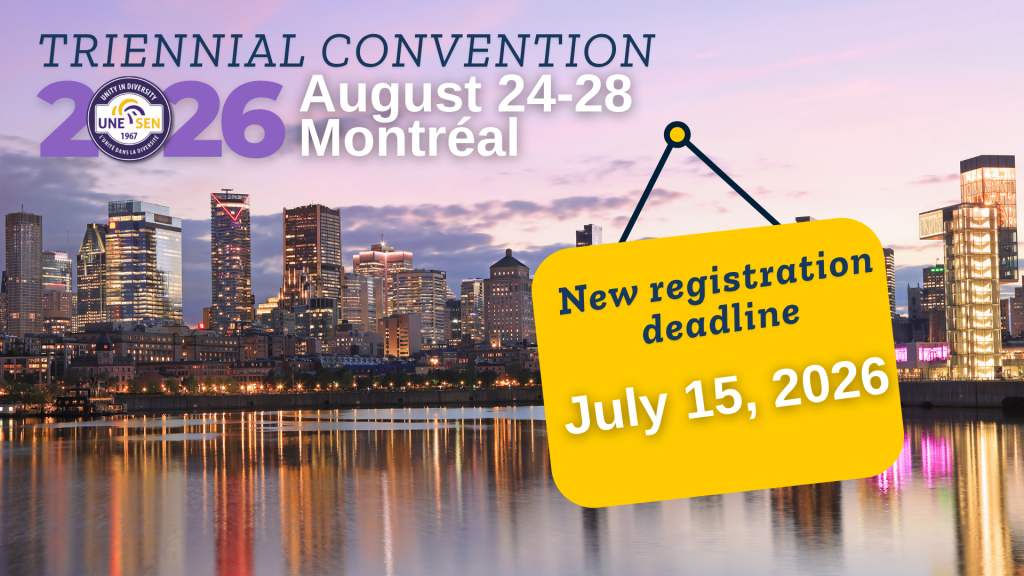
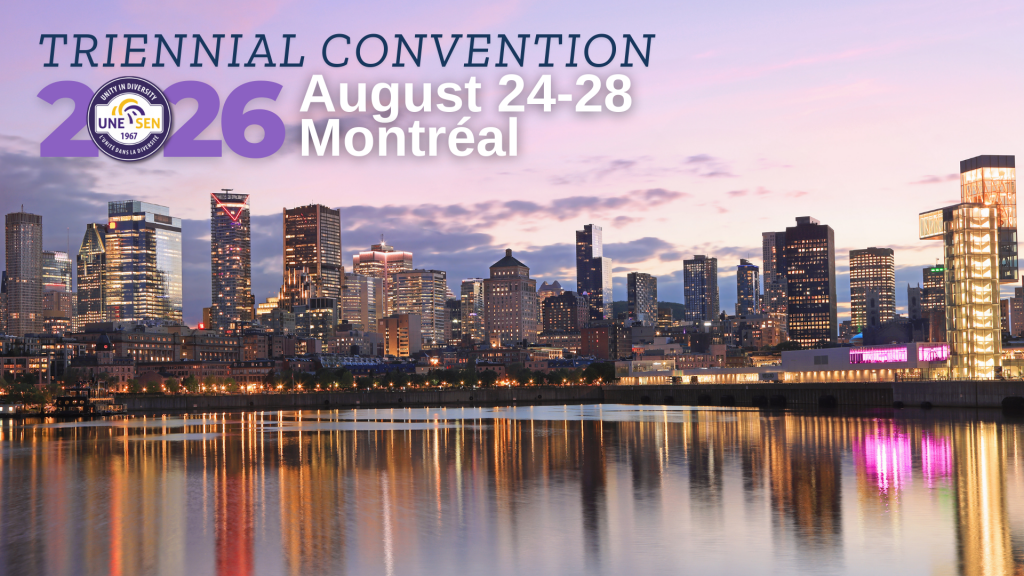
The countdown is officially on! In just a few months, UNE delegates from across the country will gather in Montréal for the 2026 UNE Triennial Convention, taking place August 24–28, 2026, at the Fairmont Queen Elizabeth Hotel.
Convention is where members come together, exchange ideas, and help chart the direction of our union for the years ahead. This is your opportunity to bring forward your experiences, your vision, and your voice.
When Convention returns, it brings with it renewed energy, long‑awaited discussions, and the chance to collectively set priorities for the future.
Delegates from locals across the country will debate and vote on resolutions, strengthen our internal democracy, and build solidarity by connecting with fellow members.
Your Local’s Role Starts Now
1. Make Sure Your Local Is in Conformance
To send delegates to Convention, locals must be in conformance by submitting the required financial documents.
2. Electing Delegates and Alternates
Delegates and alternates must be elected at a general Local meeting. The number of delegates your local can send depends on the number of members in good standing. Larger locals may send up to five delegates.
3. Observers — A Great Opportunity to Participate
Locals in conformance may also send observers at the Local’s expense, not at the member’s personal expense. Observers can attend Convention, follow the debates, and be part of the experience, but they do not participate in voting.
Not sure if your local is sending observers? Ask your local representative — you might be pleasantly surprised! Many locals welcome the opportunity to include more members in Convention activities.
Submit Your Resolutions — Your Ideas Matter
Locals are encouraged to form a resolutions committee (often 3–5 members) to review and prepare proposals from the membership. Locals may also create theme‑specific committees, such as for constitution & bylaws or finance. After debate and adoption at a general membership meeting, resolutions can be submitted online through the UNE website and must be accompanied by signed minutes.
Montréal Awaits — Be Part of This Moment
The 2026 Convention will bring together hundreds of UNE members in one of Canada’s most vibrant cities. This is our moment to reconnect, recharge, and re‑ignite our shared purpose.
We’re excited to welcome you to Montréal this summer. Let’s build the next chapter of our union — together and in solidarity.