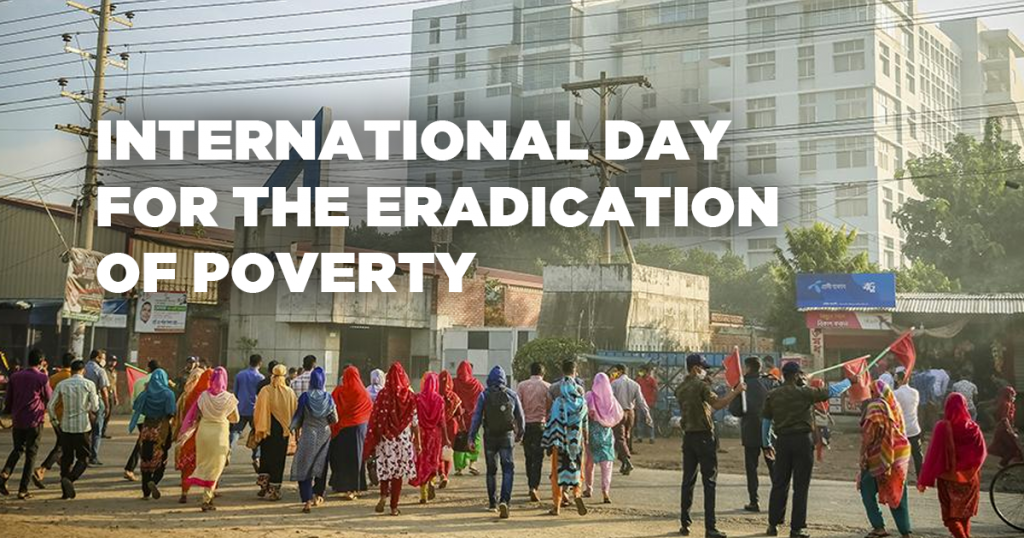
International Day for the Eradication of Poverty: Everyone deserves access to basic needs

Access to basic human rights including water, food, and housing – is increasingly at risk or out of reach for many communities in Canada and countries around the world. As a union, our fight today and every day is to raise the standard of living for all workers, secure decent and safe working conditions, and  help build equitable communities everywhere.  

PSAC’s Social Justice Fund has been supporting the Bangladesh Center for Worker Solidarity since 2013 following the collapse of the Rana Plaza building that killed over 1,200 workers and injured thousands of others.   

Bangladeshi garment workers are the lowest paid garment workers in the world – earning a minumum wage equivalent to 46 cents an hour, hardly enough to live on.   

Under constant pressure to meet production targets, garment workers take on excessive hours while their wages barely allow them to meet their basic needs. Workers are also subjected to physical and mental abuse on the production line.  

Today, we re-commit ourselves to the global fight for workers, human rights and access to basic needs for all.  

Search the landfill: PSAC welcomes new funding commitments

PSAC is pleased to see the federal government has committed funding to further study the feasibility of a search of the Prairie Green landfill for the remains of two First Nations women. 

Crown-Indigenous Relations Minister Gary Anandasangaree announced $740,000 would be used to determine the feasibility of a study on how to store and transport the hazardous materials during the search and the construction costs related to this undertaking. An initial study showed that although the search is possible, toxic materials may be hazardous to workers. The new Premier of Manitoba, Wab Kinew, has said that he hopes to work with the federal government to search the landfill quickly, but safely. 

While this is a step forward, a commitment is not action. Families deserve to mourn their loved ones with respect and dignity, and this country’s commitment towards Truth and Reconciliation is empty if we continue to perpetuate colonial violence towards Indigenous women. Continued inaction disregards the humanity of Morgan Harris and Marcedes Myran and their families. 

“PSAC welcomes the government’s commitment to a study, but more must be done in support of a full search of the landfill to bring justice to Morgan, Marcedes and their families,” said Sharon DeSousa, PSAC National Executive Vice-President. “We need to ensure that missing and murdered Indigenous women and girls and two-spirit people are treated with the utmost respect and dignity, and that all levels of government and the authorities are doing everything in their power to find them.” 

PSAC continues to urge all levels of government and the city of Winnipeg to search the Prairie Green Landfill for these women and will continue to do so until they are found. 

Join UNE National Officers on the Hill for National Day for Truth and Reconciliation Commemorative Event

We invite all UNE members in the area to join us on Saturday, September 30th, for National Day for Truth and Reconciliation to honour children who never came home and survivors of Residential schools as well as their families and communities. 

Wear your orange shirt in solidarity as we remind our government that this is only part of the reconciliation process and there is still much work to do. 

Event details:

1:00 PM – Parliament Hill, Ottawa

 National Day for Truth and Reconciliation Commemorative Event 

At 1:00 PM, we will gather on Parliament Hill to participate in the National Day for Truth and Reconciliation Commemorative Event. This solemn occasion offers an opportunity to acknowledge and honor the historical and ongoing impact of colonization on Indigenous communities. Together, we will stand in solidarity with Indigenous peoples in the pursuit of truth, healing, and reconciliation.

If you’re not in the Ottawa area, chances are there’s an event near you. Check out the website as well for daily online events and workshops – https://nctr.ca/education/coming-soon-truth-and-reconciliation-week-2023/

Convention Day Three – Human Rights at the forefront on the Convention Floor!

August 24, 2023

After the first Credentials Committee report, delegates got right back to business with the Finance Committee. The following resolutions were presented, debated and voted on:

  • FIN 1 – Removal of UNE Local Financial Review or Audit for calendar year end
  • FIN 2 – Modification to Policy FIN 1

    Delegates listened to a fantastic panel monitored by the 2023 Convention Chair Sharon De Sousa on health and safety in the workplace with panelists Uppala Chandresekara, Director of Public Health at Toronto Public Health, Fatima Gardaad, National Coordinator on Anti-Racism and Human Rights at the Canadian Labour Congress, and Andrea Peart, National Health and Safety Officer with the Public Service Alliance of Canada.

It was back to Convention proceedings for the first part of the afternoon with the Bylaws & Constitution Resolutions Committee and the General Resolutions Committee. Four resolutions were debated and voted on:

  • CS 10 – Relocation of Full Time National President and Vice-President
  • CS 4 – Increase Number of Allotted Delegates to UNE Triennial Conventions
  • Amended CS 7 – Structural Review of UNE
  • GEN 17 – Search the Landfill

    GEN 17 was an emergency resolution about launching national Search the Landfill campaign by the UNE Human Rights Committee. As stated in the resolution’s rationale, “[i]ndigenous women and girls are not disposable and deserve dignity, and the families deserve closure.” The resolution passed unanimously.

The all-candidates debate took place in the second part of the afternoon to allow delegates to discover the respective candidates’ platforms for tomorrow’s national elections.

Election Results for National Equity Representatives

A call for nominations was sent out to participants of last year’s Human Rights Conference on May 17, 2023 for the UNE National Equity Representative positions.

Results of the elections are as follows:

National equity representative for indigenous members       
Lenora Maracle 
1st Alternate: Janette Husak

National equity representative for members with disabilities
Prabir Roy

National equity representative for racialized members             
Yun-Csang Ghimn
1st Alternate: Michael Ho

National equity representative for 2SLGBTQ+   
Danielle Palmer

National equity representative for women 
Mireille Jaillet

Congratulations on your election victories!

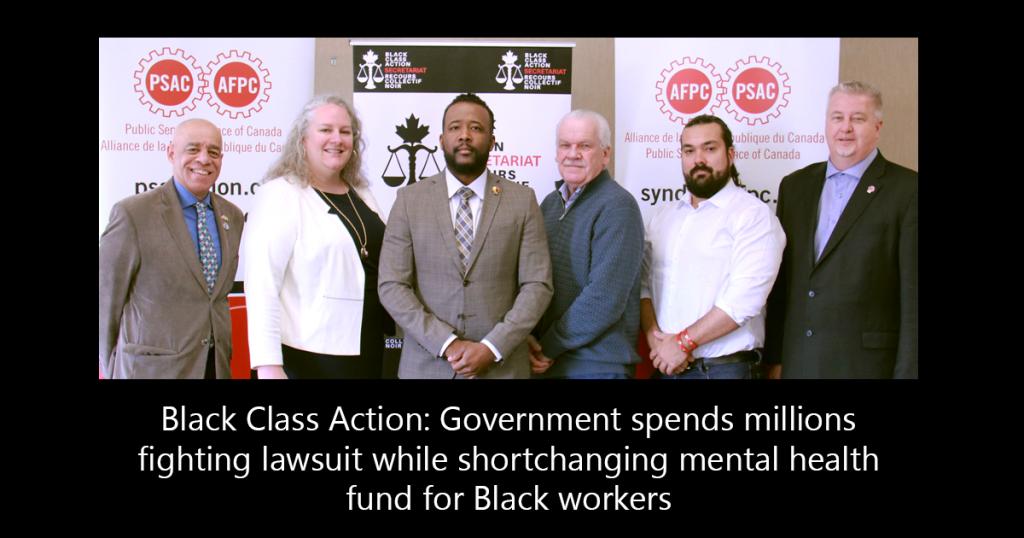
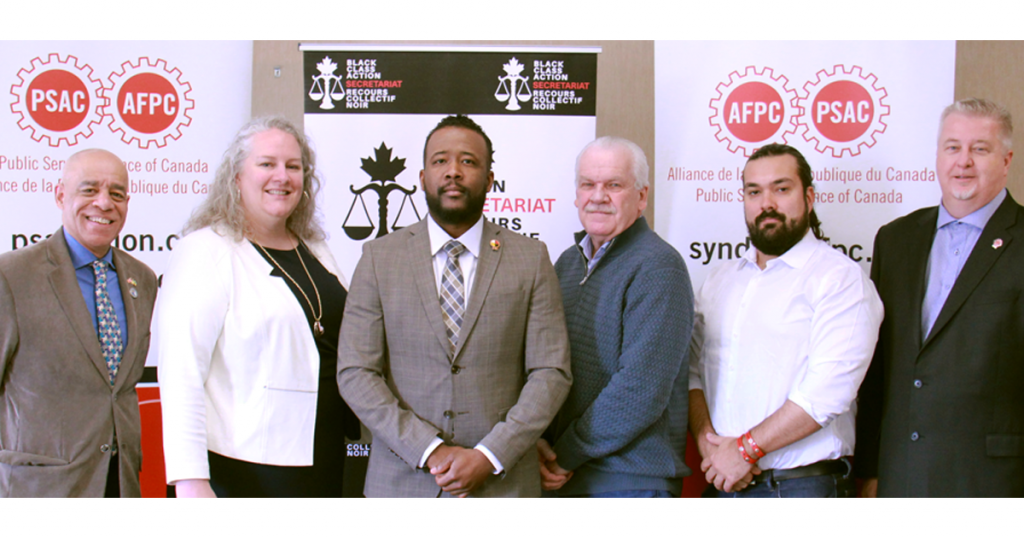
Canada’s unions call for federal government to settle Black Class Action lawsuit

The Black Class Action Secretariat and several major unions are renewing calls to settle the lawsuit on behalf of tens of thousands of Black federal public service workers in the wake of the government’s admission the Canadian Human Rights Commission (CHRC) discriminated against its Black and racialized employees.

“It is inconceivable that the federal government would spend millions of dollars fighting Black public service workers in court, when the government itself has concluded that the very institution designed to address discrimination, is discriminatory,” said Nicholas Marcus Thompson, executive director of the Black Class Action Secretariat.

The recent ruling by the Treasury Board of Canada Secretariat (TBCS) is a scathing admission that the CHRC – the government’s own human rights watchdog mandated to fight racism and discrimination – is itself plagued by anti-Black racism and systemic discrimination.

The federal government has been trying to dismiss the Black Class Action since it was launched in December 2020, arguing that the workers should pursue other avenues for redress such as filing a human rights complaint with the CHRC. This recent revelation puts the CHRC’s credibility into question as the appropriate avenue to achieve justice for Black public sector workers.

“Enough is enough. Our members deserve justice, they deserve respect, and they deserve to be made whole,” said Chris Aylward, PSAC national president. “It’s time for this government to make things right so we can move forward in creating a more equitable and diverse federal public service, free of anti-Black racism.”

The CHRC’s own figures also show the watchdog has been dismissing racism-based claims at a higher rate than any other human rights complaint.

In the 2022 federal budget, the government committed $3.7 million over four years to create a mental health program to address racial trauma and discrimination experienced by Black workers in the federal public service. However, the government has been accused of discriminating against Black workers developing the Black Mental Health Action Plan. Earlier this year, Treasury Board terminated the employees it hired to work on the plan after they raised serious concerns about experiencing anti-Black racism. PSAC has also filed grievances on behalf of those workers and has requested transparency from Treasury Board on how the Action Plan is being developed.

The Black Class Action Secretariat and Canada’s unions are calling for the government to cease its efforts in dismissing the lawsuit, and instead actively work towards redress for the workers who have been harmed and end systemic discrimination within its ranks. 

“This important legal action shines a light on systemic racism and discrimination within our workplaces, and it is a vital step towards fostering a more equitable and inclusive environment for all employees,” said Jennifer Carr, national president of the Professional Institute of the Public Service of Canada. “It is our collective responsibility to ensure that every individual is treated with fairness, respect, and dignity, and we must address the root causes of inequality in order to build a more just and compassionate society. We demand the government end its delay tactics and work with Black Class Action to bring equity and justice to public service workers.” 

“The CLC stands in solidarity with Black workers and against all forms of racial discrimination,” said Larry Rousseau, executive vice-president of the Canadian Labour Congress. “We support Black workers pursuing equity, equality, and full, fair participation in the labour market. We strongly urge the federal government to uphold the human rights of its workers and redress the injustices faced by Black federal public service employees.”   

Celebrating Black labour leadership, creating better workplaces for all

Black History Month is an opportunity to reflect on and celebrate the contributions and accomplishments of Black leaders, workers, cultures and communities across Canada. Our labour movement has been shaped and fortified by the leadership of people of African and Caribbean descent, and we are proud to build and grow in solidarity together toward a more equitable future. 

This Black History Month, PSAC invites you to register for a national virtual panel discussion on February 20, 2023 with Black leaders in Canada’s labour movement. 

Register Now 

“Black History Month is about honouring Black excellence and the continued perseverance of leadership within our communities,” said Craig Reynolds, PSAC Ontario Regional Executive Vice-President, who will moderate the event.  

“We have been at the forefront of the fight to end racism and discrimination, rallying for workers’ rights and transforming our labour movement into a powerful avenue for social change. Our accomplishments must be recognized, and our achievements celebrated.”    

Join us to celebrate Black labour leaders in Canada. Learn about the victories and challenges faced by Black labour leaders, how they bring a more inclusive approach to labour’s agenda and are shifting the landscape towards a more equitable workplace and society for everyone. 

“Black labour leaders are keeping the movement accountable to end discrimination and remove systemic barriers to make our workplaces more inclusive for everyone,” added Jan Simpson, President of the Canadian Union of Postal Workers, who will be part of the panel.  

  • WhatA virtual panel discussion to celebrate Black leadership in the Canadian labour movement 
  • Who:  
    • Craig Reynolds, Regional Executive Vice President for PSAC Ontario (moderator) 
    • Jan Simpson, President, Canadian Union of Postal Workers
    • Jason MacLean, Secretary-Treasurer, National Union of Public and General Employees 
    • Marc-Édouard Joubert, President, Regional Council, Fédération des travailleurs et travailleuses du Québec 
  • When: Monday, February 20, 6 p.m. EST 

Register Now 

The panel will be offered in English and French with simultaneous interpretation. After registering, you will receive a confirmation email with more details about joining the panel. 

Global LGBTQI Perception Index

The Council for Global Equality have partnered with Franklin and Marshall College in Pennsylvania to launch the first ever global LGBTQI perception index, which is aiming to get a comparative sense of how LGBTQI people in different countries feel about their human rights and safety in their countries. They’ve received 165,000 responses so far, but have indicated to me that the responses from Canada are fairly low, with only about 1,800 Canadians responding. They’d like to increase that number and if you are able to share this out to your networks, that would be great. I did the survey and it really is only a few questions and doesn’t take more than a minute.

Chris Little-Gagné (he/him/il)
UNE National Equity Representative for 2SLGBTQ+

Multiculturalism Works

August 12, 2022

Op-ed

Canada is fortunate to have a population that is made up of numerous distinct ethnic and cultural groups. Since the 1970s the Canadian Government officially adopted the ideology of Multiculturalism because of its emphasis on the social importance of immigration.

In the early days of the promotion of Multiculturalism, the dominant culture was very intimidated by the influx of various ethnic and cultural groups. It was often said that “if you come to Canada, you should be forced to adopt the Canadian culture”. This confused me because I didn’t fully understand what exactly “Canadian culture” was? My Canadian friends identified as Italian, French, or even European. Should I be adopting one of these cultures to be considered Canadian? Should I be eating more poutine, or adopting the word “eh” into my vocabulary? I was already using a tuque and ordering a double, double from Timmy’s. I even bought a Two-Four from the beer store for the May 2/4 long weekend, but I was still not considered Canadian enough.

When local governments began promoting multicultural events in various cities, that is when I “came out of the closet” and openly practiced my ethnic culture. I was no longer afraid to be me. I did not have to be embarrassed about practicing my culture openly in public. I could freely wear my ethnic clothing, eat my ethnic food and observe my culture’s art and music being appreciated by all. It also gave me the opportunity to learn about and appreciate the food, art and music of other cultures. It made me a more aware and appreciative person. To me, appreciating the cultures of all communities is what made me a true Canadian.

Multiculturalism is intended to encourage the various cultures to thrive in our society. I believe that a true “melting pot” would only flourish in a society that shows respect and appreciation for all cultures within that community. Some people believe that the promotion of multiculturalism would promote tribalism…. It would cause people to only interact within their own communities. That is not true. People tend to be intimidated by what they don’t know or understand. When people don’t understand the language that you speak or the religion that you follow or the food that you eat, they tend not to make the effort to integrate. This gives rise to tensions between people of different cultural backgrounds. People are too afraid that multiculturalism would result in their culture being eroded. However, the more one is exposed to other cultures, the more comfortable one become with integrating.

I believe that there are a lot more advantages to Multiculturalism than most people realize. It promotes a higher level of tolerance towards minorities, which in turn leads to a more peaceful society. When we learn from different cultures, life becomes much more exciting. It helps us to be more respectful of others and appreciate the cultural values and social norms of all. Beyond the Food and the Festivals, interacting with people of various backgrounds helps us to breakdown the ethnic or social stereotypes that one may have previously adopted. This helps us to look at things from various points of view and to work collaboratively in diverse ethno-social groups. In a multicultural society one is exposed to new ways of doing things and a different perspective of looking at things. This could only benefit us as a society.

The most important benefit of Multiculturalism is that it promotes the adoption of social justice for all. On this Multiculturalism Day let us all celebrate the diversity of all the communities in Canada and to affirm our commitment to democracy, equality, and mutual respect to all cultures in our world.

Sam Padayachee
National Equity Representative for Racialized Members

Emancipation Day

July 29, 2022

Opinion:

In 1834 the British Parliament abolished slavery in the British Empire. In March 2021, Canada’s House of Parliament finally voted to recognize the end of this atrocious part of our history by designating August 1st as Emancipation Day.

Although this day marks the end of the enslavement of People of African descent, Emancipation Day must be observed as the recognition of the struggles of all marginalized communities. A struggle that continues to this day. When we recognize the struggles of the past, we can take steps to avoid repeating those mistakes and move forward to improving the lives of all the people.

We need to realize that signing a piece of paper to abolish slavery may have ended the physical bondage of Canadians of African descent, but the mental bondage, the mental slavery still exists. Nelson Mandela said, “For to be free is not merely to cast of one’s chains, but to live in a way that respects and enhances the freedom of others”.  I believe that one way in which we can begin to erode this mental bondage is to teach the next generation of Canadians the parts of our horrendous history that has been ignored and to ensure that these atrocities never happen again. We need to learn about our true history and heritage so we can begin to move forward with the healing.

As a society, we need to come up with new and innovative ways of combating all forms of oppression that we experience today. In other words, we need to identify the social, economic, legal and political restrictions imposed on marginalized communities and ensure that appropriate steps are taken to liberate these communities. We still experience discrimination in health, housing, employment, gender, sexual orientation, and economic equality, to name a few. Until we overcome these obstacles, Canada will not be a free and just home for all of its people.

On this second Emancipation Day in Canada, let us all remember the past, reflect on the present and plan for the future. Peace, Justice and Freedom for all.

“A luta continua”

Sam Padayachee
UNE National Equity Representative for Racialized Members