There will be a lunchtime union rally April 22 from 12 – 1 p.m. to show our support for our bargaining team and to chat about questions you may have about bargaining, next steps, strike votes, and more.
When: April 22, 12 – 1 p.m. Where: 413 March Rd, Kanata, ON K2K 0E4.
We will have food and refreshments so you can attend and get something to eat during your lunch break.
As the employer continues to stall at the bargaining table, it’s important we start mobilizing and taking action now to show that we’re serious about our demands and want to get a fair deal.
Are we allowed to rally on our lunch breaks?
Yes! Members have the right to be kept informed during non-work time, before or after shifts and during paid and unpaid breaks and lunch periods. This means members have the right to participate in rallies and other union actions during your breaks as well as before or after work.
Imagine you’re part of a team that is crucial to keeping our military’s morale high and their families supported. You run programs that keep them fit, manage stores where they shop, and you’re there — day in and day out — ensuring they have what they need. Now, imagine being told repeatedly your hard work is valued, but you just won’t be fairly compensated for it.
This is what’s at the centre of the standoff between Canadian Forces Morale and Welfare Services (CFMWS) and more than 500 workers in Bagotville, Kingston, Montreal-St. Jean, Ottawa, Petawawa and Valcartier, who have been on the picket lines for more than two months.
CFMWS CEO Ian Poulter recently put out a letter with a “heartfelt call for understanding,” in which he talked about dedication and support for military families. But he seems to have forgotten who makes that all possible: the workers.
Poulter paints a picture of an unavoidable situation, where services to military families are being cut left and right because of the strike. But these workers aren’t on strike because they want to be; they’re on strike because they feel pushed into a corner, fighting for fair pay as the lowest-paid federal public service workers in the country.
CFMWS workers are mostly women, military spouses and veterans. They are already earning about half of what their colleagues earn, yet they’re being offered a mere four- per-cent-per-year pay increase. That’s not only below the Public Interest Commission‘s recommendation of 4.75 per cent, but also significantly less than the 6.8-per-cent bump higher-paid employees received last year. It’s not about wanting special treatment, it’s about demanding the same level of respect given to others. After all, don’t we all pay the same for our groceries and utilities?
The financial health of each military base — and by extension the broader military community — depends on fair treatment of all workers.
This is more than a strike. It’s a fight for respect, dignity, and recognition for the workers behind the services.
Striking workers have clearly said, “enough is enough.” If Poulter truly values the community CFMWS serves, he needs to start valuing those who make it all possible. At the end of the day, it’s not just programs and services that are at stake — it’s people. Workers who barely make minimum wage and are facing severe financial strain, with some even resorting to food banks.
The ball is in his court. Will he make a move towards understanding, negotiation and resolution, or will the impasse deepen, further straining the support for our troops and their families? The outcome will clearly show us whether the commitment to those who serve also extends to those doing the serving.
June Winger is the national president of the Union of National Defence Employees, which is a component union of the Public Service Alliance of Canada, representing more than 20,000 public and private sector workers at the Department of National Defence — including more than 500 striking CFMWS workers.
International Trans Day of Visibility is on March 31, 2024. It is an annual celebration of trans and non-binary people.
Rachel Crandell, a transgender activist from Michigan, created the day in 2009 to counterbalance the only day for trans people being Transgender Day of Remembrance (TDOR). It is important to celebrate the living as well as mourning the murdered.
International Trans Day of Visibility, and every day, is a time to celebrate trans and non-binary joy and their lives. Their human rights continue to be under attack with rising hate and anti-trans policies. They also face increased violence, especially racialized trans and non-binary people. We must celebrate their contributions to the community as well as fight discrimination against them.
StatsCan reports that “One in 300 people in Canada aged 15 and older are transgender or non-binary.” While you may not personally know a trans or non-binary person, they are your coworkers, family, friends, and community members. They have also been active in the Labour movement.
Danielle Palmer UNE National Equity Representative for 2SLGBTQ+ People
Last fall, negotiations between the House of Commons and UNE Local 70390 members in the Operational and Postal Services bargaining unit, reached an impasse. PSAC is going to arbitration before the Federal Public Service Labour Relations and Employment Board (FPSLREB).
The arbitration hearings will be taking place virtually on April 2 and 3. The hearings will be public.
This dispute resolution step, part of the long and sometimes arduous negotiation process, is unfolding because of the unwillingness of the employer to accept some fundamental bargaining demands.
“As Canadians, we should be ashamed to see the very halls of democracy treat their workers in this manner,” declared UNE National President Alisha Campbell. “When not even the House of Commons, the lower house of the Parliament of Canada, will play fair with its workers leading to arbitration, what hope do Canadian workers have at gaining better working conditions? Our dedicated members deserve their fundamental bargaining demands to be heard. If it’s a fight they want, it’s a fight they will get!”
Our members have brought forward the following demands at the bargaining table:
The implementation of a bilingual bonus
Increases of shift premiums similar to the ones various PSAC members receive
The possibility for seasonal House of Commons workers to apply for full-time positions
On top of these bargaining demands, the employer refuses to implement critical issues that PSAC successfully negotiated with Treasury Board last spring, such as:
Economic increase comparable to other bargaining units in the parliamentary precinct
Compensation for Phoenix damages that occurred in 2021
Compensation for the late implementation of the collective agreement
Expanded rights for family-related leave
Additional wage increases that reflect the ones received by other PSAC members who perform similar, sometimes identical tasks as the ones performed by our members
An additional personal day
If you have any questions about the hearing and the current dispute with the House of Commons, please contact your Local executive.
PSAC filed a policy grievance on March 12, 2024, for employer violations of several provisions in the PA collective agreement. Significant issues have come to light and former SSO members are being shortchanged by the employer.
Classification of part-time employees as shift workers, who are being offered very little hours with erratic schedules—the worst form of precarity that exists in the federal public service;
Data Collection Clerks (DCCs) reclassification not on par with similar jobs in the core public administration;
Members advised they need to complete a one-year probationary period despite their employment history;
Discrepancies between collective agreement provisions and the Employer’s adherence to those negotiated rights and entitlements.
Reduction in the hours of work across the country compared with hours before the move to PA
Sections of the PA collective agreement that are being violated by the employer include:
Article 25 Hours of work
Article 26 Shift principle
Article 27 Shift and weekend premiums
Article 28 Overtime
Article 65 Part-time employees
Although the move was welcomed at the time, the employer is creating unnecessary stress for members in what should be a straightforward process, because of an inconsistent interpretation and violations of the PA collective agreement to members of the former SSO bargaining unit.
The union is fighting to address these violations and calls on the employer to immediately act to make our members whole.
On International Francophonie Day, UNE’s Francophone Committee is calling on UNE members to take a few moments to underscore their pride in belonging to the Francophonie.
International Francophonie Day is the perfect moment to celebrate the solidarity uniting French-speaking workers everywhere.
Despite the recent modernization of the Official Languages Act by the Federal Government—the purpose of which is to increase French usage in government institutions—many indicators are pointing to a decrease in the use of French in the workplace.
This is why, now more than ever, the right to work in French must be placed at the top of the list of concerns for the labour movement.
Unions representing French-speaking workers must put in place all the tools that enhance and promote French, so that it is given all the importance it deserves in every workplace.
UNE’s Francophone Committee wishes you a great International Francophonie Day.
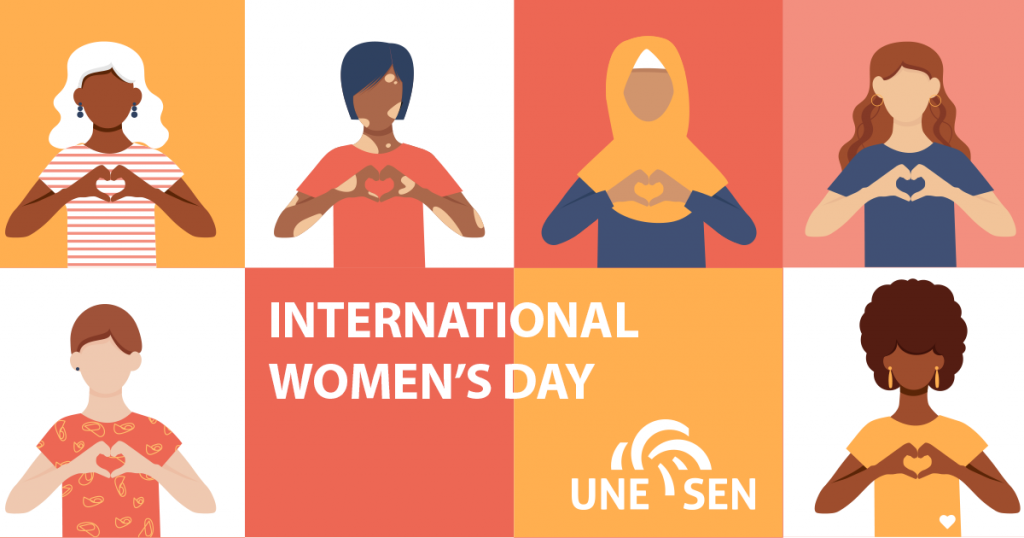
March 8th is recognized as the International Women’s Day. It is a day to celebrate and rejoice in women and girls’ social, economic, cultural, and political achievements. We take this time to raise awareness of progress made towards equality and the challenges that we still face.
We can trace the origins of the International Women’s Day to the early 20th century where we saw reflecting in labour movements across North America and Europe a call for women’s equal participation in society. While the first International Women’s Day was celebrated on March 19, 1911, the United Nation went one step further and recognized 1975 as the International Women’s year. Today, we see March 19th as a day of unity, celebration, reflection, advocacy, and action for women in many countries across the world.
The United Nation’s Motto for this year’s International Women’s Day is: Invest in Women – Accelerate progress. Investing in women is a human rights issue. Investing in women benefits us all.
Women are facing key challenges, still to this day. More and more women have been forced to live in poverty, especially since the pandemic. The evidence is clear, this crisis is gendered. Women’s participation in the workforce fell to its lowest point in thirty years. An estimated 342 million women and girls will be living in poverty by 2030. Women are losing their right to choose in some states in the U.S. How often do we see cutbacks by the government on public spending that negatively impact women and their essential services? Too often. We need to support women the best way we can. We need to allow for more space, safer space, for women to have a voice and allies to amplify that voice.
To celebrate this day and the diverse women who have persisted, showed immeasurable strength and leadership, you can wear a OFL 2024 Diversity Grows Our Strength lapel pin or t-shirt to display your solidarity and sisterhood.
Unions, community organizations, activists and the public are invited to take part in the annual March 8 Project by ordering merchandise and any surplus made from the sales will be donated to organizations that help women. In the past, such donations were made to organizations such as the Ontario Equal pay Coalition, the Ontario Coalition for Better Child Care, the Coalition of Black Trade Unionists (CBTU), Hub Club youth camps, the Strawberry Ceremony honouring Missing and Murdered Indigenous Women and Girls, Rise up! feminist digital archive, various women’s shelters and Indigenous women’s organizations.
Mireille Jaillet UNE National Equity Representative for Women
Under the leadership of the Union of National Employees (UNE) National President Alisha Campbell and with the support of the Public Service Alliance of Canada (PSAC) Administrator John Gordon and Assistant Administrator Mark Pecek, UNE exits administration.
Today marks the beginning of a new chapter for the Union and makes history in unionism and the Labour movement in Canada as the PSAC National Board of Directors voted the Union out of Administration.
For the first time in Canadian history a Black and Indigenous woman holds the office of National President of a union and a Black woman is the National Executive Vice President at the same time.
“I’m excited about the path set forward by our delegates at our 2023 UNE Convention when they elected a new National Executive to steer them out of Trusteeship and I am grateful for the support and guidance PSAC has provided us since October 2023” declared UNE National President Alisha Campbell.
UNE is one of fifteen components within PSAC and represents nearly 27,000 workers across the country and in embassies and consulates around the world. For more information, visit the UNE’s website.
As a man observing the progression of women’s rights, I find our collective understanding of equality both crucial and transformative. For too long, women have fought an uphill battle for rights that, frankly, should have been unquestioned from the start: the right to vote, to education, to equal pay, and to personal autonomy.
Acknowledging that I speak from a position of inherent male privilege must be the grounding force of this discourse. My gender has, historically and unjustly, been the benefactor of social and economic systems designed to favor men. Yet in recognizing this, it doesn’t diminish the role men must play as allies in the fight for gender equality; rather, it becomes our fundamental responsibility.
Considering women’s rights from a male perspective shouldn’t be about speaking for women. It should be about listening to their voices, amplifying their messages, and actively supporting their causes. The push towards a society that respects and upholds women’s rights is not just about correcting injustices, it is also about enriching our collective human experience.
In every aspect—from legislatures passing laws that protect and empower women, to the boardrooms ensuring equal opportunities and fair compensation, men must be proactive participants. When we overlook the contributions, perspectives, and leadership of more than half the population, we as a society stand to lose.
The protection of reproductive rights is a poignant example of where men’s voices are not to be the loudest but should echo the call made by women for autonomy over their bodies. It is not enough to be passive supporters of a women’s right to choose; men must engage in the political and social arenas where these rights are endangered.
Furthermore, the pernicious effects of toxic masculinity injure us all and perpetuate attitudes and behaviors that obstruct women’s rights. Confronting this is not an attack on manhood; it’s an evolution towards better versions of ourselves that respect and celebrate equality.
Men benefit from gender equality. In homes where domestic duties are shared, in societies where violence against women is adamantly opposed, men experience richer relationships and more stable communities. Moreover, in raising the next generation, it is imperative that boys are taught by example to view and treat women as equals.
In the end, discussing women’s rights from a man’s viewpoint is less about offering a different perspective and more about acknowledging our shared human rights. The pursuit of equality is a shared mission for the betterment of society as a whole. It is a pursuit that demands our action, not just in the public sphere but in the intimate spaces of personal relationships. Women’s rights, after all, are human rights.
Sam Padayachee is the Ontario Regional Representative for Human Rights
O’Siyo ᎣᏏᏲ “o-si-yo,” (Cherokee: I see you) Hello, Bonjour and 你好! (nǐ hǎo) union siblings.
I am very pleased to announce that Maryse Gomis has been selected as the new Executive Assistant to the Directors’ Team, under the direct supervision of the Director of Human Resources and Organizational Development. This is a brand-new position, is yet another step forward as we rebuild a stronger UNE from trusteeship. The entire UNE team is very excited to have Maryse join the organization.
Maryse joined the Labour movement in 2021 and has a vast and rich experience in executive and administrative support. She comes to us from the Canadian Employment and Immigration Union (CEUI), a Public Service of Canada (PSAC) Component, where she held the position of Administrative Assistant – National Capital Region. She also previously worked as an Administrative Assistant for the PSAC’s Programs Section/Human Rights.
Over the last ten years, Maryse has also held various administrative support positions, including as an Executive Assistant/Office Manager for Katasa Group providing administrative support in human resources, finance, and IT, as well as supporting the Executive.
She is proving to be an exceptional addition to the UNE Team. I am delighted share the news of Maryse joining our organization and know you will warmly welcome her to UNE!
Thank you, Merci, ᏙᎾᏓᎪᎲᎢ “di-da-yo-li-hv-dv-ga-le-ni-s-gv,” which means “Until we meet again”