The collective agreement is now online. You can download it by clicking here (but be warned, it’s a doozy of a file! It’s 10 MB!)
Representatives from the Public Service Alliance of Canada and Parks Canada signed the official version of the collective agreement, earlier today.
“Now that it’s signed, members will feel a lot better,” said Loretta Moar, a member on the bargaining team. “It’s a great thing for the members. I’m ecstatic about it.”
In an email sent to all Parks Canada employees, the agency’s CEO, Alan Latourelle, remarked on both parties’ efforts in reaching an agreement.
“The collaborative attitude and ongoing working relationship between PSAC and the Agency made it possible to successfully negotiate this renewed collective,” wrote Latourelle.
For Moar, the signing of the agreement marks the end of months spent tirelessly working on behalf of our membership.
“It was a lot of hard work, long hours, a lot of travel… and a lot of restaurant food,” said Moar, laughing.
But all that time spent away from home was worth it, she said. Given the current political climate, the bargaining team did exceptionally well. Moar says she’s proud of the deal the bargaining team secured for our members.
“It was a goal of mine. To be a partner to that, it was a really great feeling.”
The Union of National Employees wishes to take this opportunity to congratulate and thank all bargaining team members for their great work. Among its UNE members were Céline Ahodekon, Benoit Dubeau, Mike LeBlanc, Kevin King, and Loretta Moar.
For Loretta Moar, a first-time member on the bargaining team, yesterday’s announcement was very happy news.
“When the announcement was made, I danced around my living room,” admitted Moar. “This is great. I’m glad the membership chose to ratify the agreement.”
The bargaining team’s hard work cannot be overlooked. They spent countless hours on the road, away from home, going from one Local to another to meet with members.
And while the traveling can be tiresome, Moar says it’s not all bad.
“It was nice to meet all the members in my region!”
National Executive Vice-President Eddie Kennedy, who also works for the agency, says he’s very happy with the results and wished to extend his congratulations.
“The bargaining team worked extremely hard to ensure we got the best deal possible, given these uncertain economic times,” said Kennedy.
“She’s very happy that her daddy is home and was super glad that the collective agreement has been ratified,” said LeBlanc. “It means daddy will be home more. Her tail is up and she is purring!”
Congratulations to our members – and here’s to the bargaining team getting some much deserved rest!
To find out more about the new collective agreement, click here.
It’s been a few weeks since our members on the Parks Canada bargaining team began meeting with members all across the country to explain the tentative agreement before them. Dozens of Locals have already cast their vote.
“This is what it’s all about,” said Mike LeBlanc, a UNE member on the bargaining team. “It’s entirely up to the members – it’s entirely democratic.”
Over the past three weeks, LeBlanc has been to Kejimkujik National Park, the Halifax service centre, Halifax Citadel National Historic Site, Prince Edward Island National Park, Fundy National Park and Kouchibouguac National Park. Next week, he will be visiting three sites in Newfoundland.
LeBlanc says the reception has been really positive. Most members are very happy with the many gains proposed; some are concerned about trading the accumulation of severance pay in order to get them.
“I basically explain to our members that we can negotiate with it now, or we can have it taken away from us in the legislature later,” said LeBlanc. “If we go back to the bargaining table, the government is still going to push for severance.”
Over in Quebec, meetings are also going very well. Benoit Dubeau, another member of the bargaining team, met with members in Shawinigan last week, including Local President Daniel Toutant.
“The members listened very attentively to Brother Dubeau’s explanations,” said Toutant. “We even took the opportunity to sign up a few Rands.” Take note: that’s a great idea because members need to have a signed union card in order to vote.
“The members seemed to be really happy with the answers they received.”
Heading west a little further, Sister Loretta Moar has been meeting with members in Ontario and Manitoba. So far, she’s met with office staff in Thunder Bay, conservation members in Nipigon and members working at Pukaskwa National Park in Marathon, Ontario as well as those working at Riding Mountain National Park in Manitoba.
“The meetings so far have been very good,” said Moar. She added that most questions have centered around the severance package and payout options.
“There have been no negative comments about any portion of the tentative agreement,” said Moar.
And finally, we’re hoping Brother Kevin King has been travelling with some very warm long johns because he’s been visiting some very cold places. Earlier last week, we posted a photo of King knee-deep in the snow in Inuvik. If you don’t know where Inuvik is, it’s about a 53-hour drive north of Vancouver, in the Northwest Territories… it’s very very north!
King also visited the members in Banff earlier this month. “I spoke for about five minutes, and then answered questions for the next 25.”
His experience echoes that of other bargaining team members. “About 80% of the questions centered on the end of accumulation of severance.”
Brother King later attended meetings with members at Jasper and participated in the recent town hall against the privatization of the Canadian Rockies’ hot springs. More recently, King has been meeting with members in British Columbia along with a fellow member of the bargaining committee, Sister Céline Ahodékon.
By now, some readers might be exhausted just reading about all this travelling! The members of the bargaining team worked very hard to get to a monumental tentative agreement – and their hard work continues until they reach an agreement.
Brother LeBlanc said that while he really enjoys meeting members, he finds the travelling very tiresome.
“You’re away from home a lot. You’re staying in hotel rooms, eating at restaurants, spending a lot of time in airports or driving alone… it’s boring,” explained LeBlanc. “After a while, you almost go nuts,” he added, joking that he’s been talking out loud to himself a lot lately.
But LeBlanc says there are a few things that keep him going, such as the strong support he receives from his wife, Bernadette.
“She’s awesome! Without her support and understanding, I wouldn’t be able to be as involved as I am,” said LeBlanc with a smile. Even apart, the couple finds ways to keep in touch.
“We talk using Yahoo video, we play scrabble online together.”
However, LeBlanc says his cat, Belle, isn’t as supportive. “She isn’t supportive at all. She hates seeing the suitcase,” explained LeBlanc. “And when I finally get home, she ignores me for a few days.”
But despite the many days away from home and a grumpy cat that harbors a grudge, LeBlanc says getting a heartfelt ‘thank you’ makes it all worth it.
“At one meeting, as everyone was rushing to leave to avoid the bad weather, I noticed an older gentleman who seemed to be hanging around,” said LeBlanc. “He came up to me and said ‘I know it’s not easy work. You’ve been here a few times talking about bargaining and I want to thank you for your work because you guys don’t get thanked very often.’”
So, please, let’s all make an important mental note to thank our bargaining committee members. They work tirelessly on behalf of our members and they deserve our heartfelt thanks.
You can share your thanks right now! Please leave a comment in the box below.
With the Conservatives in charge, our country is turning into a giant auction where even our best-kept treasures are being put up for sale. Yes, that’s right; even the Canadian Rockies aren’t safe. Earlier last year, Parks Canada announced its plans to privatize the operations of three of its most iconic attractions: the hot springs in Banff, Jasper and Radium.
Last week, our members met with the local community in Jasper to find out what they thought of commercializing the hot springs — a consultation the government failed to do. Under privatization, the union expects an increase in fees or a decrease in the standards of service. That’s what happens when you take a national treasure and reduce it to a giant money-making machine.
“We opened up the floor for people to comment and ask questions,” said Marianne Hladun, Regional Executive Vice-President of the PSAC’s Prairie Region. “It was an opportunity to see if what we were thinking was accurate.”
According to Hladun, the Jasperites’ opinions were absolutely in sync with our own. Many were concerned the hot springs would turn into a playground for the elite, with spa pricing making it harder for working-class Canadians to afford.
“Fifty years ago last August, we celebrated our honeymoon at the Miette hot springs [in Jasper],” said one resident. “The reason we celebrated there was because it was the most reasonable place we could find after going to university.”
“We stayed at the cabin with the tent tops… but unfortunately they had bunk beds,” she added to much laughter from the crowd at the meeting.
The woman also expressed her concern that the commercialization of the hot springs will prevent future generations from enjoying the hot springs as her family did.
Recently, her daughter got engaged while walking along the trails surrounding the Miette hot springs.
“We love the hot springs,” she said. “It’s turned out to be a wonderful place for us.”
Help us stop the privatization of our national treasures. It only takes a few seconds to send an email to your MP using the PSAC Prairies website.
It seems that the Harper government isn’t done attacking our members. Last Sunday, some contentious changes to our nation’s employment insurance took effect.
The Canadian Press reports that the unemployed will “face stricter, more complex rules for keeping their benefits.” These changes will be especially detrimental to many of our members whose work is seasonal.
According to Service Canada, frequent claimants (those who have had three or more claims or who have received over 60 weeks in benefits over the past five years) may be forced to accept up to a 30% wage cut.
“I’m very worried about our members at Parks Canada. Last year, the Harper government cut the hours and seasons for many of our members. Now, with these changes to EI, they’re kicking them while they’re down,” said National President Doug Marshall.
Marshall isn’t alone in his concern. The Globe and Mail recently reported that Atlantic Premiers also believe that these changes are an attack on season workers:
“The people who they most seem to be targeting are actually people who are in seasonal jobs. Like, that is not an abuse. That is part of rural culture of Canada,” [Nova Scotia’s NDP Premier Darrell] Dexter said. “If they see that as a problem then they essentially see the culture of rural Canada as a problem.”
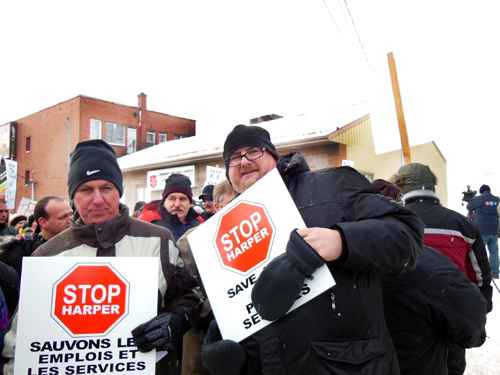
Regional Assistant Vice-President Mike LeBlanc protested the changes to EI last Friday along with President of Local 60284 Rhéal Vautour. LeBlanc said the very frigid weather didn’t deter more than 400 people from protesting Conservative MP Robert Goguen’s office.
“EI has always been there for me, but it won’t be there anymore because I’ll be deemed a repeat user,” said LeBlanc who works as a seasonal worker in New Brunswick.
“I want to work. I don’t want to be on EI, but there’s no work,” added LeBlanc. “And now we’re going to get hit hard by changes to the very social safety net that’s supposed to keep us afloat.”
LeBlanc said he’s concerned about what this means for Atlantic Canada. New Brunswick’s unemployment rate recently surged to 11.6% in October. In Miramichi, the unemployment rate hovered near 20% last April.
LeBlanc also fears the change to EI may force many New Brunswickers to look elsewhere for work.
“We want to live in New Brunswick. We love our province.”
Rhéal Vautour and Mike LeBlanc at the "scrap the EI changes" rally in front of Conservative MP Robert Goguen's office in Moncton.
The Parks Canada bargaining team has reached a tentative agreement with Parks Canada Agency.
The package includes a number of breakthroughs, including salary increases, a letter of agreement on students and a subcommittee on benefits. You can read more about the package on the PSAC website.
“Getting student language is a huge deal,” said Mike LeBlanc, an assistant regional vice-president in the Atlantic region and a member of the Parks bargaining team. The proposed package includes a letter of agreement that creates a sub-committee of the National Labour Management Consultation Committee to discuss and recommend on student employment issues.
“It’s huge – it’s monumental.”
Parks Canada has had a tendency to replace employees with students. LeBlanc said it would be great to finally have students included in the collective agreement, as they’re essentially workers. He hopes this can be the start of a process that will offer students better protections, especially when it comes to health and safety.
The bargaining team is also proud of the improvements to volunteer leave. Employees will now be able to take volunteer leave when they reach 12 weeks of work, rather than the current 18-week requirement. “It’s a little thing, but it’s still there,” said LeBlanc
Many classifications at Parks Canada were underpaid in comparison to their counterparts who work for Treasury Board. LeBlanc said the tentative agreement will finally bring the members of the PG, FI and CS groups up to par with employees of Treasury Board.
LeBlanc, who spent twelve weeks at the bargaining table, is quite happy with finally having such a great tentative agreement to present to the membership – and doing so before the NHL!
“I remember some of our members said ‘if you guys can get a deal before the NHL, you guys are good.’”
LeBlanc and the bargaining team are looking forward to visiting Locals to discuss the tentative agreement.
“There’s something for everybody at Parks Canada. Everybody is going to benefit from the things we got. I’m quite eager to go out and talk with the membership and see what their reaction is,” said LeBlanc.
The Parks Canada bargaining team was at the bargaining table in Ottawa, last week. Among its UNE members were Céline Ahodekon, Benoit Dubeau, Mike LeBlanc, Kevin King, and Loretta Maur.
What do you think? Leave a comment below!
Correction: an earlier version of this article reported that students would automatically benefit from better protections in the workplace. In fact, the letter of agreement on students opens the door for discussion at the national level on student employment within the Agency. The union hopes that this will help students get better employment provisions and help us have betterinput on student issues.
Nestled in the amazing Cape Breton Highlands National Park is a golf course; a golf course we collectively own as Canadians… for now.
The Harper government wants to put the Highlands Links golf course in the hands of a corporation. The Union of National Employees and the PSAC are fighting with all their might to keep this from happening.
This golf course, under the care of Parks Canada, is an important treasure that we must protect. Over the years, Parks Canada, with the help of hard-working public service employees, has taken great care to maintain the ecological integrity of the Highlands Links.
The golf course has also provided decent wages for hard-working Canadians in the local community. Like most public golf courses, it has also provided affordable access a sport that is notoriously expensive.
This is important to rookies, for whom the cost of private golf courses would practically bar them from strengthening their game – from pursuing their dreams.
Finally, for working-class Canadian families, public golf courses like the Highlands Links provide an affordable option for their hard-earned leisure time.
For some, there are golf courses owned by Donald Trump and the like. For the rest of us, there are public golf courses. We think that’s important. We think that’s worth fighting for.
Yesterday, hundreds gathered on Parliament Hill in Ottawa to honour police and peace officers across Canada. The Canadian Police and Peace Officers’ Annual Memorial Service pays tribute to the men and women of law enforcement who are killed in the line of duty.
It’s also an opportunity to thank to those who work so hard to keep us safe.
Among these inspirational men and women are park wardens, who are responsible for law enforcement in our national parks. They also happen to be members of the Union of National Employees.
This year, nine wardens were chosen to represent their comrades in Ottawa.
“It’s really important to recognize the important work of our law enforcement community,” said National Executive Vice-President Eddie Kennedy. Continue reading “Honouring Our Heroes”
Last Saturday, union members across the country got together to have their message heard: we’re all affected by these cuts. Thousands of our members have had their jobs eliminated – with many more job cuts to come.
Doug Marshall, the national president of the Union of National Employees, attended the event in Ottawa, where he shared his thoughts on these massive cuts.
“The government says these are just back office jobs. Well first of all, the back office is very important. The people who have contact with Canadians, that’s where they get their support. We’re not only losing those support workers, but we are losing people who directly affect the lives of Canadians in a very immediate way,” said Marshall.
The UNE, Marshall said, is very concerned about the loss of a number of crucial jobs that could put members of the public at risk, including lifeguards at Tofino Beach in B.C., fire protection officers across the country, water inspectors who keep drinking water safe for First Nations people living on reserves – and those are just a few examples.
Events all across Canada
Meanwhile, in Winnipeg, PSAC members gathered at Memorial Park with PSAC President Robyn Benson. “The crowd was electrified by Robyn Benson’s speech,” said Chris Little-Gagné, the assistant vice-president of the UNE’s Manitoba region. “We had face-painting and juice for the kids – and the grownups wrote messages to Harper on a large banner.”
“It is really disconcerting to be sitting at your desk day in and day out proudly serving Canadians and not knowing if tomorrow a [layoff] letter will show up on your desk,” said Benson.
A moment of solidarity
In Kitchener, Ontario, PSAC members rallied in Victoria Park. “In Kitchener, we have members from FedDev Ontario, Passport Canada and Parks Canada,” said Mary Anne Walker, assistant vice-president of the UNE’s Ontario region.
One affected member from Parks Canada gave an interview. Kathleen LeFaive told CTV Kitchener that she’s passionate about the work she does at Parks Canada.
“I didn’t work for money,” LeFaive told CTV. “I work in heritage because of the love history and the love of teaching.”
PSAC members in Kitchener were joined by public education teachers, who are standing up to the Ontario provincial government after the legislature passed a controversial anti-strike bill.
We have pictures of the rallies in Ottawa, Kitchener and Winnipeg. Got photos from your event? Send them to communications@une-sen.org.
Edith Bramwell, legal counsel for the Public Service Alliance of Canada, was recently interviewed by CBC Radio’s Carol Off. During the show, Bramwell spoke about a recent letter that Parks Canada sent to their employees about their duty of loyalty, calling it “something in the nature of a gag order.”
The letter, sent late last month, asks Parks Canada employees to refrain from public criticisms of the Government of Canada.
Bramwell says the letter gives the impression that any criticism of the government would violate the duty of loyalty. “That is a gross restraint on people’s political rights and their rights to freedom of expression,” she added.
“If you’re in a coffee shop and you’re criticizing the Harper government and there’s someone sitting beside you and they know you work for a government department, technically you’re in violation of the code of ethics.”
Bramwell added that, given the current job cuts, some employees may fear that they could lose their job for speaking out. “That’s simply not appropriate. That’s simply not what the duty of loyalty is meant to say.”
The PSAC is currently working on a guide for members on the code of ethics and their right to speak out. We’ll let you know the minute it comes out! In the meantime, if you’re asked to take part in a media interview, please contact the UNE’s communications officer or your assigned labour relations officer.