A day of heartbreak

A day of heartbreak

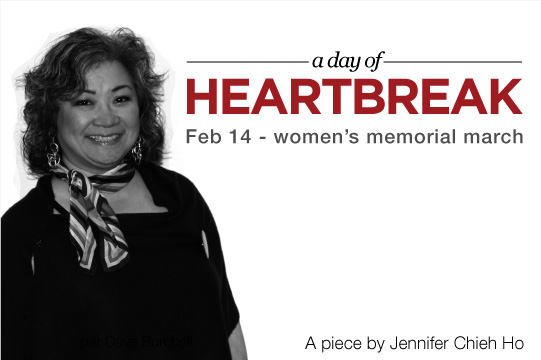
Each year on Valentine’s Day, people smile, hug and greet each other with a joyful “Happy Valentine’s Day!” — for others, it’s a day of heartbreak.  For them, February 14 is a day to commemorate their lost loved ones and take part in memorial marches across Canada.

This year marks the 21st Women’s Memorial March through the Vancouver Downtown Eastside, an area where many First Nations women have fallen victim to violence. Nationwide, there are over 600 women on the Native Women’s Association of Canada’s missing or murdered list.

“In January 1991, a woman was murdered on Powell Street. Her name is not spoken today, respecting the wishes of her family. Her death was the catalyst to move women to take action leading to this special Valentine’s Day March,” wrote organizers of the march at the Carnegie Community Centre.

Unlike last year’s rainy day, our members were fortunate to have some great weather. I was pleased to be joined by sisters from the UNE BC Region, along with sisters and brothers from the PSAC Vancouver Regional Office, the PSAC Women’s Committee, the PSAC Human Rights Committee and other grassroots organizations.

When we first arrived, we were greeted by a First Nations sister who gave each of us a beautifully decorated card. Each card had a unique proverb honouring the murdered women. Mine read, in part, “death leaves a heartache no one can heal, love leaves a memory no one can steal.”

Before the march started, we gathered inside the Carnegie Community Centre Theatre, where families of the missing and murdered women shared their stories. The speakers showed tremendous strength as they did so. Someone said, “our loved ones are in a better place; they don’t have to suffer anymore. They may be looking at us, from wherever they are, and wanting to tell us that they are alright.”

Outside the center, there were drums, chanting, singing, praying and greetings. A First Nations brother generously gave fresh bannock to activists of all ages; he was content to see smiles it brought to their faces. Close by, an elder conducted a smudging ceremony to attract good spirits and positive influences.

Among the crowd, I saw a woman crying. I placed my hand on her shoulder to comfort her and was rewarded with a giant hug. The emotions were contagious. We cried, hugged, shared stories and supported each other. We were all there for the same reason.

As the march started, thousands filled the streets, carrying banners, pictures, ribbons, posters and handmade quilts in commemoration of those who were taken from us. While most marchers were aboriginal, many others, of all ethnicities, young and old, marched in solidarity.

The crowd stopped at sites where women were last seen or were found murdered. Each stop was acknowledged by a cedar smudging ceremony. The crowd attracted others who joined the march as it moved along. And just like they do each year, eagles joined the march from above.

The march ended with a candlelight vigil to commemorate the missing and murdered women of the Downtown Eastside.

Being part of this was a great and unforgettable experience. It’s a reminder to keep fighting for women’s rights and for justice for our stolen sisters.

Jennifer Ho
Regional Vice-president of the B.C. and Yukon region
Union of National Employees
International Day of Persons with Disabilities

International Day of Persons with Disabilities

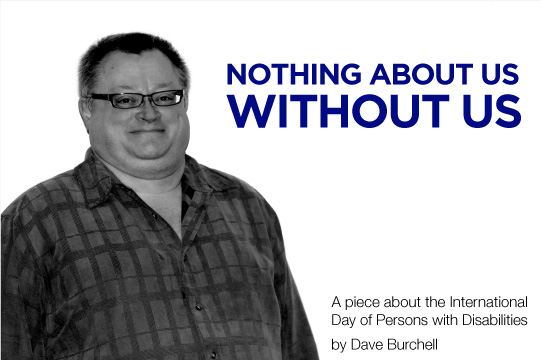
My name is Dave Burchell and I am the Union of National Employees Representative for Persons with Disabilities.

I wish to remind you that today, December 3, is the International Day of Persons with Disabilities.

The United Nations Decade of Disabled Persons was held between 1983 and 1992. It urged governments and organizations to make the necessary changes to improve the lives of disabled persons all over the world.

In 1992, as this decade drew to a close, the UN General Assembly proclaimed December 3 as the International Day of Disabled Persons.

In 2007, the assembly changed the name from the “International Day of Disabled Persons” to the “International Day of Persons with Disabilities”. The new name was used the following year.

This year’s theme is “Together for a better world for all: Including persons with disabilities in development”. My personal favourite was in 2004 when the theme was “nothing about us, without us” made a bold statement which rings constantly in my ears.
Canadian census data reveals that the number of persons who reported having a disability reached 4.4 million in 2006, or 14.3 per cent of the Canadian population at the time.

Persons with disabilities face many disadvantages and are still subject to stigma and discrimination. They are largely excluded from civil and political processes and remain overwhelmingly voiceless in matters that affect them.

I hope that you will join me and all other Union of National Employees and PSAC members, persons with disabilities and their allies in remembering the daily struggles we go through to achieve what able-bodied and sound-minded individuals take for granted. It is indeed a challenge for us, but with your help and the assistance of individuals who care, we can all be identified as ‘people, rather than persons with disabilities.

Trans Day of Remembrance

Trans Day of Remembrance

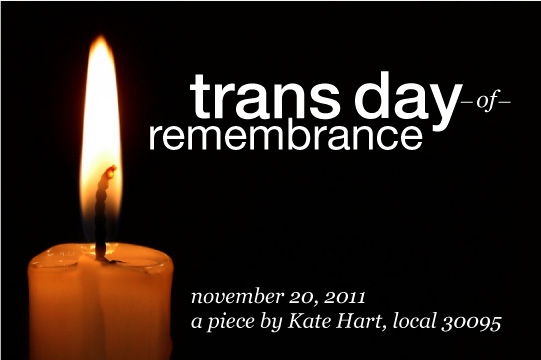
As we approach November 20, the Trans Day of Remembrance, I wish to challenge my union brothers and sisters.

If you truly wish to remember and honour my dead brothers and sisters, then support our battle for human rights equality in this country. They have died due to violence, bigotry, hatred and societal neglect.

Most of you will understand violence, bigotry and hatred. But do you understand societal neglect? It’s a form of abandonment that says “I have my rights, so what’s the big deal?” Have you ever been told you weren’t allowed to use a washroom appropriate to your gender or been asked to leave one because someone told you that you don’t belong there? Have you ever been denied accommodations or been fired for being yourself?

This is a daily fact of life for many in my community. There are segments of society that would make it illegal for me to use a gender-appropriate washroom in public. There are those that would say it’s okay for me to be denied housing or a job because of how I was born.

There are also those that would take more direct action because, somehow, I offend their delicate sensibilities as to what they deem “right” or “normal” or even “acceptable”. Those are the people that beat, maim and kill my brothers and sisters – and would potentially do the same to me.

I do not like having to live my life in a heightened state of awareness, always performing an ongoing threat assessment of those around me. I do not like having to constantly make mental notes of exits and escape routes. But for me, and those like me, that is the world we live in.

Our world is like this because we are denied rights enjoyed by others – fundamental rights that never even cross your mind. In the eyes of many, we are somehow less than human and not deserving of the rights enjoyed by the majority.

I am here to tell you we are as human as the rest of you. I am here to tell you that I am as equal as everyone else around me. Just because I do not fit into some people’s preconceived notions of the binary nature of gender does not mean I deserve to die, be beaten, maimed, spit on, or maltreated.

The labour movement has always fought for equity and equality for all its members. It has been at the forefront of almost every major step forward in advancing the rights of workers. In many cases, these advances have been mirrored legislatively, not long after. Furthermore, these advances have helped to shape human rights legislation in multiple jurisdictions.

To me, this is a fundamental union principle. It’s no different than the fight to bring women into the workplace or the fight for pay equity.

This is about equity and equality for all of us. It is the right thing to do.

So, here is my challenge for you:

  1. Make this a core demand in the next round of bargaining with the employer, and don’t let it be dealt away.
  2. Contact your brothers and sisters in the union, at the local and national levels, and tell them to stand up and do what is right.
  3. Phone, write or email your MPs and tell them that this is an important issue. Ask them to support the reintroduction of the bill explicitly enshrining these rights in the Canadian Human Rights Act.

The question is not “why should we do this?” – the question is “why shouldn’t we?”

We all know this is the right thing to do. Now we just have to do it.

Kate Hart
Human Rights Rep.
Local 30095
Union of National Employees

Standing together against racism

Standing together against racism
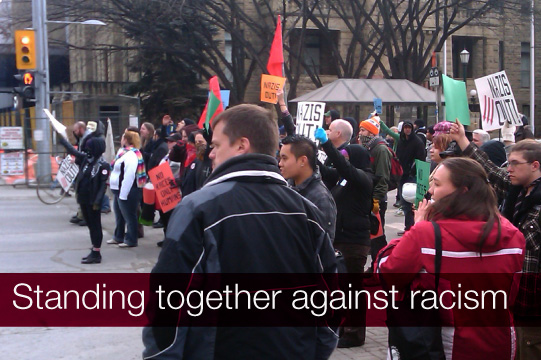
Geoff Ryan, ARVP for AB, NWT and NU taking part in an anti-racism protest

March 21 is the International Day for the Elimination of Racism. This day reminds us that racism still exists in our society – and that is unfortunate.

On March 18 and 19, the National Component was holding a regional seminar in Calgary. For the past few years, a white supremacist group called Blood and Honour has held “white pride” rallies to coincide with the International Day for the Elimination of Racism in Calgary.

That morning, when I read the article in the Globe and Mail describing the white pride rally and the leader of Blood and Honour, I became angry – angry that there are people who feel that they are better than everyone else because of their skin colour or their religion. I was angry that these people felt they could go march the streets to spread their message of racial supremacy.

I had to do something; I could not let this go. I asked members at the western seminar if they would join me in protesting the white supremacist rally. I was happy have about 30 National Component members join this anti-racism protest. We met up with about 170 other like-minded folks who shouted slogans towards the Blood and Honour group for about an hour. At least I felt like we had done something positive.

Racism in any form is just wrong. We all have a responsibility to help eliminate racism, whether it is taking part in an anti-racism protest, speaking up against inappropriate jokes, or just accepting people as individuals and getting to know them a bit better. Talk to someone who is different than you and you will learn about that person – you will also be helping to make our society a better place for the next generation.

– Geoff Ryan
Assistant Regional Vice-President for the Alberta, Northwest Territories and Nunavut Region.

Flickr More photos are available on our new FlickR site! Please click here!