PSAC stands with Black public service workers in class action lawsuit

December 4, 2020

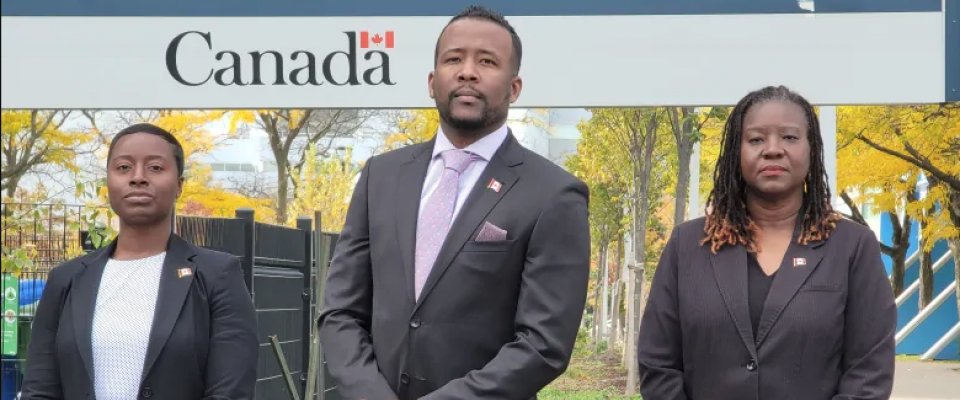
The Public Service Alliance of Canada supports the legal action taken on behalf of nearly 30,000 past and present federal public service workers who identify as Black, Caribbean or of African descent. PSAC intends to serve as an intervener in the class action lawsuit filed against the Government of Canada by Black public service workers who have been subjected to discriminatory hiring and promotional practices.

Anti-Black racism is prevalent in Canadian society and the federal public service has not been immune. For far too long, many of our members have experienced the pain of Black employee exclusion; the systemic practice of limiting skilled Black workers from career advancement opportunities and being disproportionally underrepresented in management and high-ranking positions in the federal public service.

The class action, which has been filed with the Federal Court of Canada, argues that Black employee exclusion has led to economic and psychological harm for thousands of public service workers since the 1970s. The claim calls on the federal government to implement a plan to truly diversify the federal public service and provide restitution to tens of thousands of Black public service workers.

PSAC’s support of this class action strongly aligns with the union’s ongoing fight against anti-Black racism.

“Canada’s public service presents itself as a ‘merit-based, representative and non-partisan organization that serves all Canadians,’” said Chris Aylward, PSAC national president. “While laudable as a principle, many Canadians, particularly Black Canadians, have experienced a different reality. The government must do what is necessary to right these wrongs and ensure that these injustices do not continue.”

PSAC echoes the calls of our Black public service members. The federal government must identify and tear down systemic barriers in its human resources practices. It must take action to increase diversity and inclusion within its ranks, especially in positions of leadership. We also expect the government to listen to Black workers and take their lead on how to correct this gross injustice.

The federal government has acknowledged that systemic racism is prevalent in Canadian society and within government institutions. If this government is truly committed to tearing down systemic racism, it must begin with its own hiring and promotion practices. Canada’s public service is richer and better served when it is made up of workers with diverse perspectives and lived experiences.

Source: PSAC stands with Black public service workers in class action lawsuit | Public Service Alliance of Canada (psacunion.ca)

PSAC recommits to eliminating all forms of gender-based violence

December 4, 2020

On National Day of Remembrance and Action on Violence Against Women, PSAC remembers the fourteen young women who were killed at l’École Polytechnique on December 6, 1989, only because they were women, and today, PSAC also recommits to ending all forms of gender-based violence. 

On this day, we remember:

Geneviève Bergeron

Hélène Colgan

Nathalie Croteau

Barbara Daigneault

Anne-Marie Edward

Maud Haviernick

Barbara Klucznik Widajewicz

Maryse Laganière

Maryse Leclair

Anne-Marie Lemay

Sonia Pelletier

Michèle Richard

Annie St-Arneault

Annie Turcotte

In Canada today:

  • 75,000 women and children seek shelter from violence and abuse each year;
  • Homicide rates are seven times higher for Indigenous women and girls than amongst non-Indigenous women and girls;
  • Immigrant women are more vulnerable due to economic dependence, language barriers and a lack of knowledge about community resources;
  • Trans women are almost twice as likely as cisgender women to experience gender-based violence in their lifetime;
  • Women with physical and cognitive impairments experience violence two to three times more often than women living without impairments.

COVID-19 makes it harder to fight gender-based violence. Job loss, food insecurity or the fear of contracting the virus can trigger domestic violence. Social isolation and quarantines make it harder to access shelters or sexual assault centres. Those living in rural, remote and northern regions, immigrants and refugees and Indigenous women continue to be the most vulnerable populations, and the pandemic is isolating them more than ever before.

The heightened risks caused by the pandemic require immediate action. PSAC calls on all levels of government to:

  • Provide increased emergency funding to women’s shelters and sexual assault support centres, and identify ways to make services accessible in the context of physical distancing measures;
  • Work with health facilities and community organizations to quickly identify available local resources;
  • Include essential services to address violence against women in their response plan for COVID-19.

PSAC’s work to prevent violence against women continues. Our union is proud to have negotiated 10 days of paid domestic violence leave in all new federal government collective agreements to ensure those facing domestic violence begin to get the support they need. We also continue to pressure governments to implement all recommendations from the National Inquiry into Missing and Murdered Indigenous Women and Girls report, and to eliminate barriers to accessing legal and counselling support for women experiencing violence.

PSAC is calling all members to participate in Canada’s 16 days of activism against gender-based violence, from November 25 to December 10, by taking action to eliminate its root causes.

Source: PSAC recommits to eliminating all forms of gender-based violence | Public Service Alliance of Canada (psacunion.ca)

International Day of Persons with Disabilities: Don’t Forget to Remember

December 3, 2020

Persons with disabilities are some of the most resilient and strong-willed people that I know. They seem to take bumps and hiccups all in stride; something of a challenge, yet still achievable. Not insurmountable. To some, those bumps and hiccups look all-consuming, or even life-crippling. But to a person with a disability, there is a way to manage.

There has to be.

There is no other choice.

It just needs to be found.

And find it we do.

But for some, that strength and resilience is only a façade that is held tightly as if a display for the public. In some strange way they believe that that strength and resilience is what the public wants to see, even needs to see so that they can go about their day and their business without giving a second thought, and for some without giving even an initial thought, as to the actual well-being of another.

Because, let’s face it, why would they?

Everything seems ok.

Everything looks ok.

What do you mean “Things may not be as they seem?”

Out of some sense of self preservation, some insular sense of self-protectionism, the public gets the façade while behind the façade is not what the public would be lead to believe.

The truth of the matter is that living with a disability is exhausting and isolating. It’s those little things that seem so insignificant that add up to a mountain of extra load. It’s those missed opportunities or the avoidance of situations that further deepens the sense of isolation. Persons with disabilities  sometimes do things for all the right reasons yet achieve all the wrong results.

Don’t forget to remember.

Check in with people, all people; persons with a disability or not.

Establish, or deepen a connection on a heart-to-heart level.

Respect the façade but also look through it; let wellness be your guide.

Be a part of the lives of the exhausted and isolated. Help them to remain resilient and strong.

By Michael Freeman

UNE National Equity Representative for Persons with Disabilities

International Day for the Elimination of Violence against Women

November 25, 2020

November 25, 2020 is International Day for the Elimination of Violence against Women. Why is this important, many will ask? Here are just a few facts provided by the United Nations.

  • Alarming Figures 1 in 3 women and girls experience physical or sexual violence in their lifetime, most frequently by an intimate partner
  • Only 52% of women married or in a union freely make their own decisions about sexual relations, contraceptive use, and health care
  • Worldwide, almost 750 million women and girls alive today were married before their 18th birthday, while 200 million women and girls have undergone female genital mutilation (FGM)
  • 1 in 2 women killed worldwide were killed by their partners or family in 2017, while only 1 out of 20 men were killed under similar circumstances
  • 71% of all human trafficking victims worldwide are women and girls, and 3 out of 4 of these women and girls are sexually exploited
  • Violence against women is as serious a cause of death and incapacity among women of reproductive age as cancer, and a greater cause of ill health than traffic accidents and malaria combined

We are in 2020 and these are facts that women are still facing daily. We all have a role to play in ending gender-based violence against women, girls and LGBTQ2+ individuals. It is time to join the uncomfortable conversations around what is violence towards women and how to be part of the solution.

Becoming an Ally to Women!

  • Listening: be open to learning from the experiences of others
  • Believing: support survivors and those affected by violence
  • Speaking out: add your voice to call out violence
  • Intervening: find a safe way to help when you see acts of gender-based violence
  • Acting: give your time to organizations working to end violence 

We need to start somewhere, and this is the one place I am passionate about – Not only because I am a woman, BECAUSE I am a woman. No woman should feel powerless, EVER! We are not the weaker sex. We are just as powerful as men in different ways!

EMPOWERED WOMEN EMPOWER WOMEN!

No woman should ever feel powerless! I grew up being told I was strong, smart, beautiful and I could be anything I wanted, and I only owned my body. Listen to your gut, it never lies to you. I have been lucky. I am sure I have put myself in places I should not have. I have never been a survivor of violence; here I have been blessed.

I have, like all other women, had attention and things said to me that should never have been said to me growing up. Not knowing how to handle it or what to say or do. Being told it is just the times or just part of the job. I worked as a waitress in bar, all was part of getting tips.

Awhile ago, a friend of mine showed me a picture of a woman holding a sign and on it was a sentence crossed out and below was another. The one below was powerful and true!

She was raped.

He raped her.

This sign changed how I looked at the words we say and how we view them. What they say are powerful tools to fight against violence towards women. I went searching for more examples and found many others.

We have all heard the saying” Stick and stones can break your bones, but words can never hurt you.” This is so not true. When these statements are what you see and what you hear, society believes them and passed on and it becomes the norm. Let us start by breaking that cycle.

Here are a few more things we need to change:

Educate our sons

Will fight for our safety until we get it!

No such thing, an underage woman is a child. Children cannot give consent. They are RAPED, rape victims, sexual assault victims, sexual assault SURVIVORS!

This is a polite weasel word for RAPE and rapists do not deserve politeness. Victims deserve validations for what they have been through.

Will be held accountable for their actions. This is not an excuse! (Just like girls are).

Clothes are just clothes; they do not talk! No girl, woman or LGBTQ2+ individuals asks to be RAPED!

I am not naïve to know that violence towards women, girls and LGBTQ2+ individuals will stop over night just by changing a few sentences though it is a great first conversation. It is a step forward in understanding how we look at women, blame them for the violence against them, and how we usually victimize the victim in the crime. This is a necessary element to highlight in the elimination process of violence against women. It is a step in the right direction to stop this preventable epidemic.

Diana Walker

UNE National Equity Representative for Women

Trans Day of Remembrance: COVID-19 has increased barriers faced by trans and non-binary people, especially if racialized

November 20, 2020

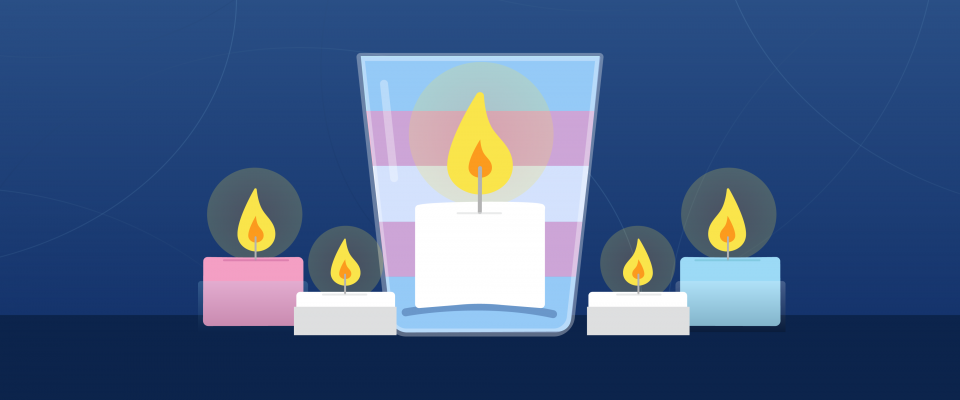
Today, we mourn trans, two-spirit, non-binary and gender non-conforming people who have lost their lives to transphobia. November 20th is Trans Day of Remembrance (TDOR) which began in 1999 by trans advocate Gwendolyn Ann Smith as a vigil to honor the memory of Rita Hester, a trans woman who was murdered in 1998. On this day, PSAC mourns the loss of those who were loving partners, parents, family members, friends and community members. 

Although there have been many recent gains in trans inclusion in Canada, trans people, especially racialized trans feminine people, continue to be disproportionality affected by gender-based violence. COVID-19 has only exacerbated the discrimination and inequities these individuals face. 

COVID-19 & Its Impacts on Trans People 

The pandemic has been a challenging time for everyone, but individuals in trans and non-binary communities have faced additional barriers during the spread of COVID-19. Accessing hormones and gender-affirming surgeries has been especially difficult. Since trans and non-binary people are more likely to work precarious jobs, they have also experienced a loss of income and job security.  

A survey conducted prior to COVID-19 indicated that 12% of respondents avoided going to the emergency room because they were trans or non-binary. Discrimination and these pre-existing health barriers have been heightened due to COVID-19.  

Trans and non-binary people have also faced an increase in the impacts of domestic violence in their homes in times of isolation. Furthermore, social distancing measures have had a detrimental impact on the mental health of many.  

Racialized Trans & Non-Binary People 

Reports show that racialized trans and non-binary people in Canada experience additional challenges and discrimination. In 2019, Trans Pulse Canada conducted a survey with 2873 trans and non-binary people across the country. Racialized respondents reported higher levels of discrimination, violence and assault than their non-racialized counterparts. 73% of respondents expressed fear towards police and expected unfair treatment by the legal system. Nearly 3 in 4 respondents reported being verbally harassed within the last 5 years. 

Many Black trans people report feeling disproportionately targeted and harassed by police. The recent death of Coco, a 30-year-old Black trans woman living in Toronto, while she was in the custody of the Toronto Police Services, is another stark reminder of the dangers racialized trans women face regularly. 

What can you do commemorate TDOR? 

You can participate in TDOR by attending and/or organizing a vigil on November 20th to honor  trans and gender non-conforming people whose lives were lost due to transphobia. We encourage you to participate in a digital vigil taking place online. If you are attending a vigil in person, we remind all members to take appropriate COVID-19 safety precautions (wear a mask, physical distancing, wash hands, etc.) 

You can also encourage your Member of Parliament to pass the Conversion Therapy Bill (Bill C-6) once and for all. Conversion therapy is the damaging practice of denying LGBTQ2+ people their dignity and trying to coerce individuals to change their identity. It hurts children, adults and tears families apart. You can read more information on the legislative action against conversion therapy, endorsed by PSAC.   

What can you do beyond TDOR? 

There are ways you can support trans and gender non-conforming people every day: 

  • Demonstrate your trans allyship through respecting the trans people in your life. 
  • Never assume another person’s pronouns, and always use the ones you are asked to. 
  • Upon meeting someone new, share your pronouns with them to demonstrate your solidarity. 
  • Include your pronouns in your email signature, business cards or in your displayed name during video conference calls. 

Source: http://psacunion.ca/trans-day-remembrance-covid-19-has-increased?_ga=2.89560594.829289535.1605885128-1121130890.1580157739

Changes to 699 leave: PSAC to take further legal action

October 29, 2020

PSAC is filing a second policy grievance against Treasury Board for its most recent discriminatory changes to 699 leave that will force federal workers to exhaust all other leave – including sick leave and vacation leave – before they can request “other leave with pay” for COVID-19-related reasons.  

For the past eight months, federal public service workers have been giving their all to help Canadians grapple with the COVID-19 pandemic. PSAC members have been unwavering in their dedication despite the physical risks for those doing front-line work, in additional to ongoing school and daycare closures, and the extra burden of taking care of vulnerable family members.  

In some cases, workers have been forced to use 699 leave when they simply could not work remotely because of child care or elder care responsibilities, including waiting in long lines for COVID-19 testing. 

Despite the modest use of 699 leave, in May Treasury Board changed the guidelines on 699 leave to restrict how public service workers use “other leave with pay” to fulfil childcare needs related to COVID-19. 

PSAC warned Treasury Board that tightening the guidelines would discriminate against marginalized groups, potentially lead to serious human rights violations and violate members’ collective agreements. Workers have a right to use 699 leave because we negotiated it into collective agreements; it cannot be taken away at the whim of managers. 

They didn’t listen.  

Shortly thereafter, PSAC filed a policy grievance against Treasury Board on the grounds that the revised policy disproportionately impacts women, people with disabilities and people with family obligations.  

New policy forces members to exhaust all other leave 

Even before PSAC’s first hearing date with the Public Sector Labour Relations and Employment Board, Treasury Board doubled down on their restrictions around 699 leave, revising their policy to state that 699 leave could only be considered if workers have depleted all other paid leave available to them, even if they are suffering from COVID-19 symptoms or are unable to work because of child care or family obligations.  

PSAC will therefore be filing another policy grievance for the latest 699 leave policy changes that come into effect on November 9.  

Every day, parents are pulling their sick kids out of schools and daycares and will be forced to use up their vacation and sick leave. Workers caring for elderly relatives must make the impossible choice of putting their loved ones at risk if they go to work and bring COVID-19 home with them. These changes violate both members’ collective agreements and the Canadian Human Rights Act based on family status, sex and disability. The Canadian Human Rights Commission also plans to make submissions on behalf of federal public service workers.  

Without the availability of a vaccine, and with many parts of Canada experiencing a second wave of the pandemic, Treasury Board’s proposed changes are premature and do not reflect the current reality of this public health crisis and its mental health impacts on public service workers. 

PSAC is committed to ensuring that our members, and in particular, women, caregivers and those with disabilities, continue to have the necessary support and leave with pay they need during the pandemic. 

Source: http://psacunion.ca/changes-699-leave-psac-take-further-legal-action

Women’s History Month

When approached to do this article for Women’s History Month, I pondered writing it solely from the perspective of a woman, which is my undeniable fact, but how can I write only from this vantage point, when I am also a BLACK WOMAN, and that too is an undeniable fact. My own personal intersectionality reads like the characters out of Shakespeare’s Hamlet, Rosencrantz and Guildenstern, the literary knife and fork, like my duality, inseparable and interchangeable.

As I sit to write, I acknowledge to you my gender and my equity, my knife and my fork. Each day, every day, I live with the barriers and challenges of sexism and racism, for this too is my intersectionality; being black and being a woman are both of my identities. I cannot ever stop thinking about racism, it is not a choice, it is my reality.

I have been preoccupied with thoughts of injustices, heightened after the deaths of Regis Korchinski-Paquet, Breonna Taylor and of course, who could forget, the brutal and inhumane murder of George Floyd. I watched (as we all did), in horror as he gasped for air and begged for mercy, all 8 minutes and 46 seconds of “reality television”, one that could easily be my reality.

This year the theme for Women’s History Month is #becauseofyou, I have been mulling this over in my mind and wondering how this translates into my life, not only as a woman, but also as a black woman. Women and Gender Equality Canada (WAGE) states, “This year’s theme… is inspired by those here in Canada and around the world who work to advance gender equality in their communities”. Somehow, this is not relatable to me and does not seem to include my lived experiences, not in the way I think it is intended. I work in my community, in my union, trying to always bring and utilize the lens of my equity as a woman while challenged by my equity of my race. Most times, I feel that I am failing my community, failing to do enough. Racism against blacks have cornered me into a reality that encompasses:

#becauseofyou I am fearful

#becauseofyou I feel silenced

#becauseofyou I feel powerless

#becauseofyou I feel hopeless

#becauseofyou It is unsafe to stand up for my rights

#becauseofyou I feel ignored

#becauseofyou I am invisible

#becauseofyou I am hyper-vigilant

#becauseofyou I am angry and hurt

In this climate of racial unrest, many women, mothers, nurturers are fighting the effects of emotional fatigue, having to face the new and revisit the old, as attempts are made to navigate the landscape of those now “woke” and demanding change. It is difficult to get people of privilege to care, care after the protests are over, the coalitions have disbanded, the hashtags are no longer trending on Twitter and the social media pages have shut down.

How do you get them to continue to care and remain invested when no one is looking and notoriety is nowhere in site?

As activists, the term ‘’safe spaces” is bandied about but it is those who have privilege that are positioned to create said safe spaces destined for those of us who find ourselves struggling for and demanding equality. It is in this way that they have the best of both worlds, with the choice to hang up their walking shoes, their activism apparel and retire into their own achievements. This simply does not exist for the Black woman.

The privileged amongst us are able to wield the baton of allyship, a privilege that can be used as an advantage or they can simply choose to walk away. For me, I am unable to leave my blackness at the door, just as much as I am unable to dismiss the very nature of my womanhood. Despite the inherent conflict that my intersectionality creates, it also enables the re-creation of one’s own perception of gender and race, my very own Rosencrantz and Guildenstern.

#becauseofyou I will be strong

#becauseofyou I will not give up the fight/struggle

#becauseofyou I will be determined

#becauseofyou I will not silence my voice

#becauseofyou I will stand up for what is right

Hayley Millington
UNE National Equity Representative for Racially Visible People

UNE Supports the moderate livelihood fishery of the L’nu

Indian beadwork

Between 1725 and 1761, the L’nu, also known as the Mi’kmaq, signed treaties of peace and friendship with representatives of the British crown.  These treaties did not cede lands and included the right to harvest natural resources to support a moderate livelihood.  These treaties have not always been upheld by the crown, as evidenced by the arrest of Donald Marshall Jr. in 1993 for catching and selling $787.10 worth of eels. 

Marshall, who had been recognized in 1990 by a royal commission that identified racism as a factor in his wrongful imprisonment for murder, went to the Supreme Court to uphold his fishing rights. The 1999 Marshall decision affirmed Mi’kmaw treaty rights to a moderate livelihood from hunting and fishing. The Supreme Court clarified their decision later that year by stating that the treaty rights were still subject to government regulation. 

In September 2020, the Sipekne’katik First Nation, frustrated by the lack of recognition for their treaty rights in federal fisheries legislation, launched their own self-managed lobster fishery with licenses for 350 traps. The seven small boats were met by commercial fishers in larger boats who harassed them, stole, or cut loose their traps and vandalized their boats. While the commercial fishers’ representatives cited conservation issues, many racist taunts were heard on the waters and seen on social media. The Sipekne’katik lobster fishery represents about 0.1% of lobster harvesting in their area, and their off-season harvesting is not considered to be a conservation issue by fisheries experts. 

Similar conflicts have been happening in Mi’kma’ki since the Marshall decision 21 years ago, with federal officials and law enforcement failing to intervene in many cases. 

The Union of National Employees (UNE) recognizes that we are all treaty people and encourages our members in the Atlantic Region and across Canada to uphold treaty rights. October is Mi’kmaq History Month.

Helen Zebedee
UNE Regional Representative for Human Rights, Atlantic

Orange Shirt Day

Native People and non-native people of Canada will be honouring the Indigenous residential school survivors and remember those who did not survive by wearing orange shirts. Orange Shirt Day was started in 2013. It was created to educate people and promote awareness about the Indian residential school system and the impact this system had on Indigenous communities for more than a century in Canada, and still does today.

The Orange shirt has become the symbol of overcoming adversity. Why orange? Because of Phyllis Jack Webstad from the Stswecem’c Xgat’tem First Nation, who went to St. Joseph Mission Residential School. On her first day of school, Phyllis wore a new orange shirt that her grandmother had given her. It was immediately taken away, and that was the start of Phyllis’s alienation from her family and community, a genocide caused by actions of the church and the federal government.

Many Indigenous children, about thirty percent of indigenous children were sent to Residential Schools. Students were taught English and punished for speaking their Native language. However, Canada‘s residential (boarding) schools inadequately preparing students to live in white society or to return to their reserves. Europeans main goal was to “Kill the Indian in the Child”.

Orange Shirt Day is a time for us all to remember those events and to make aware to mainstream society what happened to Indigenous children because it is not in the history books, and the intergenerational effects on today’s indigenous population. This day shows the continuing strength and resilience of Indigenous peoples.

Lenora Maracle
UNE National Equity Representative for Aboriginal Peoples

UNE Multiculturalism Day

By Hayley Millington

Multiculturalism, the very idea in itself speaks to an ideology, a policy enacted by Canada’s government that gave birth to the perception that people of different cultures could co-exist within the wider framework of society. For the most part, Multiculturalism can be defined as the co-existence of diverse cultures, where cultures includes racial, religious, or cultural groups and is manifested in customary behaviours, cultural assumptions and values patterns of thinking and communicative styles. Canadians refer to the cultural mélange as its very own Multicultural mosaic.  

As you read this article, you may ask yourself what exactly does multiculturalism entail?  Well, here in Canada, at the core of Multiculturalism was immigration placing it in a position of social importance. Historically speaking, in Canada, during the 1970s and 1980s, the government officially adopted Multiculturalism and this is reflected in law through the Canadian Multiculturalism Act of 1988; as well as it being mirrored in section 27 of the Canadian Charter of Rights and Freedoms. The policy itself is administered by the Department of Canadian Heritage.

On June 27, 2003, Canada celebrated its first Multiculturalism Day, an opportunity for Canadians to reflect on the uniqueness of Canada’s multicultural mosaic as it relates to the contributions of Canada’s immigrant populations, cultural communities and the values that we all share.

One can say that the diversity displayed by Canada has shaped the wider society and subsequently our way of life. Through Canada’s immigration, people from around the world have made Canada their home with the expectation of having, dare I say, the same opportunities and experiences as all “Canadians”.

As a black Trini-Canadian woman and one of the immigrant populous, I’d like to bring into focus the reality, irrespective of the misnomer that is multiculturalism. In recent weeks, we have had a rude re-awakening as present day events have only served to deconstruct the notion that Canada is immune to racism. The belief, fuelled by the sentiment that Canada, unlike the US, has exercised racial tolerance can be traced back to the country’s role in the Underground Railroad and Canada being a safe haven for runaway slaves.  “Stories” like these have added to Canada’s perception of itself and even contributed to how Canada is viewed on the worldwide stage. This kind of persona has provided its inhabitants with a false sense of security that denies the existence of racism as a tangible reality as black Canadians face systemic racism on all fronts.

Multiculturalism has in no way made us as a country, a society immune to the depravity of a life challenged by inequality and racial injustice. We each should be reminded that a truly multicultural society is one that we have not yet attained and is but a work in progress.

Canada’s strength lies in its diversity and now is not the time to turn a blind eye and miss the opportunity to eradicate the inherent racist policies and practices that litter Canada’s multicultural landscape and institutions while sullying Canada’s vision for a society that genuinely values diversity and richness along with the contributions of all its citizenry.

I would be remiss to not mention how Multiculturalism and inclusivity seems a distant goal as it remains lost and elusive to the people native to this land whose past and present struggles continue to be dis-regarded, dis-respected and dismissed.

These concepts should be a given to all that call this land, whether by birthright, by birth or through immigration, home.    

In Solidarity, I ask you to stand up, speak out, become an ally and align yourself with your fellow citizens who continue to live their daily lives plagued by the pestilence of racism and discrimination for a multicultural society reflects the true meaning of inclusivity, and not simply for the reasons of celebrating another’s culture or sampling their fare. It requires each individual’s commitment and attention. The events of the recent past demand it.

Hayley Millington is the UNE National Equity Representative for Racially Visible People.