Retired or former employees who meet the eligibility criteria will receive financial compensation for each fiscal year in which they are eligible. However, you will not receive compensation automatically. To receive Phoenix general damages, retired or former employees will have to file a separate claim form through Treasury Board. This will include the estates of deceased employees.
Despite numerous requests by PSAC, Treasury Board has yet to set up this claims process. We are continuing to press them for information on the implementation plan and will post the information on our website and social media accounts once the form is available.
PSAC members will receive their Phoenix general damages in one lump sum payment on March 3 with their regular pay and it will be taxed at source. PSAC is deeply disappointed with the government’s decision to move ahead without a decision from CRA on taxability and continue to pursue the issue with CRA directly. We have also raised the recurring issue of not separating special payments from regular pay – as was recently the case with retro payments.
Individual details about your Phoenix general compensation payment will be available in MyGCPay (only available on the Government of Canada’s internal network).
If you have any questions about your Phoenix damages payment amount, please first contact your Human Resources specialist for the payment breakdown. If members still have concerns, they can reach out to the Client Contact Centre. For other information about Phoenix general damages, please visit our frequently asked questions.
Current PSAC members who were granted compensatory time under another union’s Phoenix settlement agreement may not receive the full amount ($2,500) on March 3 and may receive additional payments at a later date. Consult the federal government’s webpage for more information on how your Phoenix damages payment may be calculated if you were under multiple bargaining agents or an excluded employee during any of the fiscal years of the Phoenix agreement.
PSAC will monitor the situation closely to ensure that all our members receive complete and detailed information about the settlement implementation.
PSAC has been informed that the federal government plans to move forward with taxing Phoenix general damages on March 3rd and that they will not provide the Canada Revenue Agency (CRA) with information they requested in order to revisit their initial opinion on taxability.
It is completely unacceptable for Treasury Board to deny CRA the information they need to provide a revised opinion before issuing the general damages payments. Their own letter to PSAC confirms that CRA is willing to work with them to revisit their opinion based on the facts raised by PSAC – information that CRA was not provided by Treasury Board originally. This is a crass attempt to interfere with the review by CRA and to expedite the claw back of the Phoenix damages settlement.
On the very week of Phoenix’s 5th anniversary, the government has found yet another way to hurt PSAC members impacted by years of pay problems.
CRA relied on information from Treasury Board when it issued an initial opinion about the tax implications of the Phoenix settlement. The opinion contained a number of errors and when these errors were pointed out by PSAC, particularly with regards to general damages for pain and suffering, CRA agreed to re-issue an opinion if Treasury Board joined us in clarifying the facts. Treasury Board has refused to cooperate, denied that they even understood this mutual agreement between the three parties, and are openly stating to members that general damages are to be taxed – despite the fact that they are blocking CRA’s ability to revisit their opinion.
If their disregard for our members continues, it could ultimately lead to thousands of unnecessary tax challenges and lengthy retroactive payments.
Next steps: Going to CRA directly
With the government refusing to cooperate, we have decided to submit our own declaration of facts to CRA directly, along with case law addressing the awarding of damages and those damages not being subject to taxation. CRA traditionally only engages with employers to provide opinions of taxability, but it is possible that they may choose to consider the new facts that we provide them.
We will report back to the membership as soon as we have an update to share on this front.
Why wasn’t taxability negotiated in the settlement itself?
The short answer is: we can’t do that.
The union and employer, the parties to the agreement, cannot dictate to CRA how it interprets tax laws. The taxability of damages is determined by what the money is intended to compensate for. The parties added specific language in the agreement to specify that the general damages were for “stress, aggravation, pain and suffering” in recognition of the impact on members lives. There is a strong precedent of damages for those purposes being deemed non-taxable.
What if CRA maintains its opinion in light of the government’s actions?
In the coming weeks, if CRA refuses to issue a new or different opinion due to the government’s inaction, members will have to force an official ruling from CRA by making individual appeals.
PSAC is doing everything we can to avoid this outcome as it puts the burden on our members to file the appeals, but if it becomes our last option, we will develop streamlined systems to support members in making the claims quickly and easily.
It is our top priority that PSAC members receive the full compensation that we negotiated, and which they deserve. We will continue to update members as we work to bring this to a conclusion.
PSAC’s Statistical Survey Operations bargaining team will be holding online bargaining information sessions across the country to bring members up to speed on the issues at the table.
Negotiations between PSAC (Regional Offices and Field Units at SSO) and the employer kicked off in early December, with bargaining continuing January 27-28. New dates have also been set for the first week of March.
Negotiations were delayed in part due to the pandemic and the lengthy hiring process of a new employer negotiator.
During the information sessions, SSO members will have the opportunity to discuss the bargaining proposals put forward by both PSAC and the employer.
PSAC’s core bargaining demands include:
Better job security, hours of work and schedules;
Improved maternity and parental leave benefits;
Greater protections against harassment and abuse of authority;
10 paid days of domestic violence leave;
Improved shift premiums for evenings and weekend;
Leave improvements for sick leave, family leave, vacation leave and compassionate care and caregiving leave.
Discussions continue on these and other proposals as the negotiation process gets underway.
PSAC national negotiator Hassan Husseini is working with bargaining team members across Canada to organize the online bargaining information sessions over the next few weeks. Please stay tuned for announcements from your local about upcoming meetings in your region.
We encourage you to make every effort to attend and stay informed about the issues at stake.
The Parks Canada agreement expires on August 4, 2021. It is time for you to submit bargaining demands, as part of the 2021 round of negotiations for the Parks Canada Agency.
How can I submit Demands?
Locals should schedule a membership meeting to discuss their priorities and proposed bargaining demands.
Once bargaining demands are agreed upon, members are encouraged to submit their bargaining input by completing the PSAC online form.
KEY DATES
Deadline to submit bargaining demands: March 12, 2021
Deadline to submit your application to be a delegate at the virtual National Bargaining Conference: March 26, 2021
Virtual National Bargaining Conference: May 31 to June 2, 2021
As we are celebrating Black History Month, we invite you to take this quiz by UNE National Equity Representative for Racially Visible People Hayley Millington to learn more about the legacy of Black Canadians.
Question #1: The first black man to set foot on Canadian soil was a free man. True or False?
Answer: True. His name was Mathieu Da Costa, a free man who was hired by Europeans to act as a translator.
Question #2: Where did the first shipload of enslaved Africans arrive in British North America (BNA)?
Jonestown
Jamestown
Georgetown
Trenchtown
Answer: The first shipload of enslaved Africans arrived in Jamestown.
Question #3: What is the connection between Father Paul Le Jeune and Olivier Le Jeune?
Answer: Olivier Le Jeune was the first enslaved African of New France. Olivier was 6 years old when he arrived in New France and was the property of Sir David Kirke. He received his education by Jesuit priest Father Paul Le Jeune. Father Le Jeune was his last owner.
Question #4: In which code was slavery for economic reasons stipulated?
Answer: Louis XIV’s Code Noir permitted slavery for economic purposes.
Question #5: This King of France permitted colonists of New France to own Black slaves and Pawnees, Aboriginal slaves. True or False?
Answer: True. For more information on slavery in New France: Slavery.
Question #6: This slave set fire to her master’s Montreal home and destroyed 50 homes in Montreal. She was tortured and hanged as an object lesson for all blacks. Who is she?
Answer: Her name was Marie-Joseph Angélique. She allegedly set fire to her master’s Montreal house and destroyed nearly 50 homes.
Question #7: Runaway slaves fled to Canada via:
Greyhound bus
Via rail
Underground Railroad
Horse and buggy
Answer: The Underground Railway was created in the early 19thcentury by a group of abolitionists based mainly in Philadelphia, Pennsylvania. The term Underground Railway began to be used in the 1830s. It was a complex, clandestine network of people, secret routes and safe houses.
Question #8: What was the Imperial Statute?
A. A statue of King Louis XIV
B. A statute about the enslaved only having to be fed and clothed
C. A statute about any child born of enslaved parents be free at 25
D. Anyone released had to ensure that she/he could be financially independent
E. A only
F. All the above
G. Number B-D
Answer: G
Question #9: This group of Blacks left Halifax to relocate to which African nation?
Answer: Black Loyalists realized they would never find true freedom, so they left Halifax, almost 1200 of them, to relocate in Sierra Leone.
Question #10: Upper Canadians were shocked when Chloe Cooley, an enslaved woman from Queenstown, was beaten and bound by her owner and transported across the Niagara River to be sold in the US. This incident convinced Lieutenant-Governor Simcoe that the abolition of slavery was necessary. True or False?
Answer: True. Upper Canadians were shocked when Chloe Cooley, an enslaved woman from Queenstown, was beaten and bound by her owner and transported across the Niagara River to be sold in the US. English law made prosecution impossible and the incident convinced Lieutenant-Governor Simcoe that the abolition of slavery was necessary. The Act to Limit Slavery in Upper Canada was enacted in 1793.
Question #11: Who were the maroons and where, in Canada, did they settle?
Answer: A group of 600 freedom fighters landed in Halifax in 1796. These immigrants, called Maroons, came from a Jamaican community of escaped slaves who had guarded their freedom for more than a century and fought off countless attempts to re-enslave them.
Question #12: Slavery was abolished everywhere in BNA in 1834, and in 1793, Upper Canada (now Ontario) passed the Anti-Slavery Act. True or false?
Answer: True. Slavery was abolished throughout the British colonies by an Imperial Act, called the Slavery Abolition Act, which became effective as of August 1834.
Recently, Treasury Board outlined their strategy to increase diversity and inclusion in the federal public service. One of their key commitments was to review the Public Service Employment Act to improve diversity in their hiring practices.
PSAC welcomes this review. An overhaul of the federal government’s staffing system is long overdue to address systemic barriers that impact our members from marginalized groups.
Staffing issues are one of the most important issues raised by employees, and we hear countless stories from our members who’ve experienced racism, sexism, ableism and discrimination during the hiring process. Many members also feel like they don’t have proper recourse to deal with discrimination because they fear retaliation if they file a grievance or a complaint.
But sweeping legislative changes to the Act can’t be made without meaningful consultation with PSAC and other bargaining agents as well as federal public service workers who have been negatively impacted by the hiring process. We must also strengthen the Employment Equity Act, which the government has promised to review as well.
New report charts path towards diversity and inclusion
A report on employment equity released by the Public Service Commission this week confirms that employment equity groups are not proportionately represented throughout the recruitment process. The report offered three recommendations:
A call to action for departments to review their hiring practices, identify and remove barriers and improve the success of employment equity groups in the various stages of hiring.
For the Public Service Commission to look at system-wide barriers across the public service to uncover and address the root causes of those barriers.
To require mandatory training on unconscious bias in recruitment for all public service managers and strengthen supports for those managers.
We fully support these recommendations to address the unfair and opaque staffing practices in the federal public service that disproportionately impact our members from marginalized groups. But these recommendations alone are not enough. These barriers are not new, and under-represented groups have waited far too long for action to be taken to improve representation in the public service.
PSAC will continue to tackle systemic racism and discrimination in the federal public service. Canada’s public service is stronger and better-served when it is made up of workers with diverse backgrounds, perspectives, and lived experiences.
The 2021 UNE Triennial Convention has been rescheduled to be held virtuallySeptember 13-17, 2021.
If you have already registered, you will be contacted with updated information as it becomes available. Please note the new deadlines below if your Local has not yet elected delegates, alternates or observers.
Locals are encouraged to hold elections through virtual membership meetings.
NEW DATE – May 13, 2021 is the deadline for resolutions, delegate registration and for your Local to be in conformance.
Make sure your Local is in Conformance You can only attend Convention if your Local is in conformance. For a complete list of documents needed from your Local, see the Convention section of the UNE website.
Elect Delegates and their Alternates Delegates and alternates are elected during general Local meetings. The number of delegates per Local is determined by the number of members in good standing six months before the start of Convention as per UNE Bylaw 6, Section 11:
Four to 100 members = one delegate;
One delegate for each 100 members or portion thereof to a maximum of five delegates for any given Local.
Observers Locals in conformance can also send observers to Convention at the Local’s expense. These members can attend Convention, but they cannot participate in debate or vote.
Submit Credential Forms Credential forms for each delegate, alternate and observer must be submitted to UNE. Credential forms for delegates and alternates must include a copy of the general Local meeting minutes showing the election of those members. The credentials forms are available for download on the Convention section of the UNE website.
Registration Deadline
To be recognized as a delegate to Convention, members must complete the online registration and submit the following documents by May 13, 2021:
Credential forms, including meeting minutes showing election of delegates and alternates;
Local financial documents in conformance with UNE Bylaws and Policies.
Members who miss the deadline will not be able to participate on Convention committees and are considered late delegates. Late delegates are seated at Convention by way of procedural motion during the early stages of the opening of our Convention.
If you require additional information, please contact Suzanne Boucher, Convention Coordinator, at events@une-sen.org or at 613-560-4359 or 1-800-663-6685.
RESOLUTIONS
Option 1
Locals should appoint a Convention resolutions committee; these are normally made up of three to five members. Some Locals may prefer to appoint a committee for each resolution topic: constitution and bylaws, finance, and general resolutions. Your Local should issue a notice asking members to submit resolutions to your Convention resolutions committee. Allow plenty of time for the committee to prepare a report. Members of the committee should also be encouraged to submit their own resolutions. Each committee’s report and additional resolutions should be presented during a general membership meeting. This meeting should provide ample time to debate resolutions before members cast a vote.
Option 2
Any member in good standing can submit a resolution to Convention by having it co-signed by five other members in good standing.
Submit Your Resolution Online
You should submit your resolutions electronically on our website. Completing this process significantly reduces the time required to prepare resolutions for committee review in June. If you do not have internet access, you can submit your resolutions by mail or fax.
Submit Supporting Documentation
The resolutions you submit online must also be supported by hardcopy versions of either the signed minutes verifying that the resolution was adopted during a general membership meeting or the resolutions form co-signed by five other members in good standing. You can download the resolution template on our Convention page here.
Please send these hard copies to the attention of Ateau Zola by email at resolutions@une-sen.org.
You can also submit by fax at 613-560-5208, or by mail at: Union of National Employees 900-150 Isabella St. Ottawa (ON) K1S 1V7.
Resolutions received after May 13, 2021 will be deemed late and will be dealt with after all other resolutions.
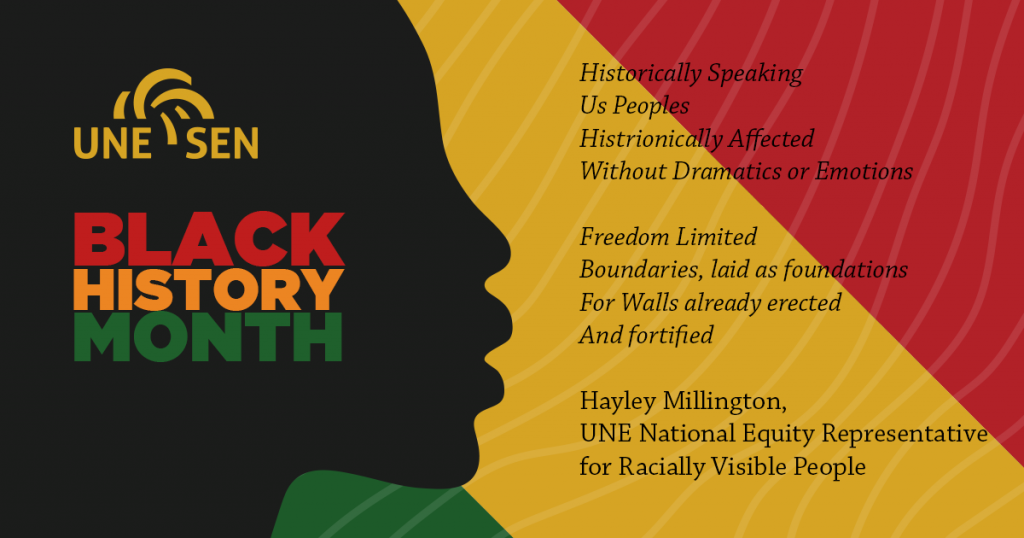
During the month of February, Canadians are invited to participate in Black History Month (BHM) activities and events that honour and recognize the legacy of Black Canadians, both past and present.
For 2021, as February approaches, the focus centers on Black History Matters: Listen, Learn, Share and Act, which recognizes the important legacy of people of African descent and the long-standing history in the development of Canada.
February signals a time for Canadians to celebrate the many achievements and contributions of Black Canadians who, throughout history have contributed to Canada’s rich mosaic.
It is important to bring awareness to the fact that persons of African descent have been a part of shaping Canada’s heritage and its identity since the arrival of Mathieu Da Costa, a free black man who acted as a navigator and interpreter for the Europeans back in the early 1600s.
Notably, the role of people of African descent in Canada has not always been highlighted in Canada’s historical landscape. As such, we see little mention of the Loyalists who came here after the American Revolution and settled in the Maritimes and that they were people of African descent. Not to mention the patriotism and sacrifices made in wartime by soldiers of African descent as far back as the War of 1812.
Surprisingly enough, few Canadians are aware of the fact that African people were once enslaved in the territory that is now referred to as Canada. Furthermore, they are unaware, that those who fought enslavement also helped to lay the foundation of Canada’s diverse and inclusive society.
Black History Month is a time to learn more about these Canadian stories and the many other important contributions of Black Canadians to the settlement, growth and development of Canada, and about the diversity of Black communities in Canada and their importance to the history of this country.
The commemoration of Black History Month dates back to 1926, when Harvard-educated African American historian Carter G. Woodson proposed setting aside a time devoted to honour the accomplishments of African Americans and to heighten awareness of Black history in the United States. This led to the establishment of Negro History Week in 1926. Celebrations of Black history began in Canada also shortly thereafter. During the early 1970s, the week became known as Black History Week. It was expanded into Black History Month in 1976.
In December 1995, the House of Commons officially recognized February as Black History Month in Canada following a motion introduced by the first Black Canadian woman elected to Parliament, the Honourable Jean Augustine. The motion was carried unanimously by the House of Commons.
In February 2008, Senator Donald Oliver, the first Black man appointed to the Senate, introduced the Motion to Recognize Contributions of Black Canadians and February as Black History Month. The motion received unanimous approval and was adopted on March 4, 2008. The adoption of this motion completed Canada’s parliamentary position on Black History Month.
With all that being said I encourage you to take some time and delve into the History of people of African descent… Black History Matters.
Hayley Millington UNE National Equity Representative for Racially Visible People