Bill C-59 on Collective Bargaining: Despite the Law…

BillC-59Danger

If you thought the Harper government was pulling the wool over the eyes of Canadians in order to further their maligned agenda, you’re mistaken; they’re doing it in plain sight. The Conservatives were bold enough to include language in Bill C-59 that says quite simply that the Treasury Board can establish terms and conditions of employment “despite the Public Service Labour Relations Act”.

Now, seeing as the Act is described as “An Act respecting labour relations in the public service,” how can this be seen as anything but a violation of the Charter of Rights And Freedoms as well as disrespect towards government employees and their families?

This is union-busting, period.

“We are in the midst of negotiations with Treasury Board right now,” said UNE President Doug Marshall. “Bill C-59 tells us that the government has no interest in good-faith bargaining, no regard for the Canadian constitution and the law, and no respect for workers.”

The budget was released just ahead of the PSAC’s recent triennial convention where delegates unanimously passed an emergency resolution to develop a meaningful campaign to oppose government actions that compromise members’ rights.

“We need people to understand that this government is doing whatever they want,” insisted Marshall. “We will defend our right to collective bargaining and we will not be intimidated by bully tactics such as this.”

As the campaign unfolds, the UNE will share this information with members so they have the knowledge and tools to fight back against the attacks the Harper regime is forcing on Canadian workers and families.

Bill C-59 puts into effect the Conservative budget of April 21, 2015, a budget that has made it apparent to our members, and to all Canadians, that this government has to go.

In that budget, the Conservatives unveiled their latest attempt to deceive Canadians with their Pinocchio budget; nothing more than number juggling, spin, and propaganda, in order to meet the Harper government’s promise of a balanced budget.

Up until a couple of years ago, the government has never even included a line item for sick leave. And that is because it is not now – and has never been – a financial liability. The Parliamentary Budget Officer and Statistics Canada have said that there is no cost for the current sick leave system.  In contrast, the government would have to pay a private insurance company millions of dollars to administer a short-term disability plan.  In spite of the facts, the government says that eliminating sick leave will result in a $900 million savings.

The government sold GM shares, but it claimed that the proceeds from the sale of shares would count as income.  No accountant would agree that this is income: if we sold our home for $300,000, that doesn’t mean that we have $300,000 of added income!  To add to the fraudulent accounting, although the Harper government received about $3 billion for the latest share sale, in total, the government received billions of dollars less than what it originally paid.

In order to produce a surplus, the government also claimed another $2 billion in income, which was “earned” by stealing two-thirds of the money set aside in a contingency fund for disaster reliefs.

This is not a balanced budget; it is nothing more than a slick Ponzi scheme. To make matters worse, the budget implementation law proposes to steal away the constitutional right to free collective bargaining.

We simply cannot afford another Conservative government. Not a majority – not a minority – not at all. We have to spread the word that this is unacceptable.

Negotiating teams postpone bargaining with Treasury Board over Budget Act

NegotiationsPostponed

PSAC bargaining teams for the core public administration and separate agencies met today to discuss their response to the government’s decision to gut collective bargaining rights in the recently tabled Budget Implementation Act. Bargaining teams all decided to postpone this week’s round of negotiations in order to assess the implications of the government’s violation of our members’ rights, and evaluate all possible actions to defend them.

The Budget Implementation Act (Bill C-59) authorizes Treasury Board to rip up collective agreements to remove sick leave and impose a short and long term disability plan outside of negotiated agreements. The Bill will circumvent the Public Service Labour Relations Act as well as ongoing negotiations.

“In light of the recent attack by this government against our members, our elected bargaining teams have decided not to engage in the scheduled round of negotiations this week,” said Robyn Benson, National President of PSAC. “This government is obviously acting in bad faith and have decided to bully their way into getting what they want, in complete disregard for the Charter of Rights and Freedoms and existing collective agreements.”

The Supreme Court established the right to collective bargaining as a Charter right. Bargaining teams were strong in their resolve to defend our rights using all means at our disposal.

PSAC’s recent National Triennial Convention recently voted to use up to $5 million to protect members’ rights and promote public services.

Bargaining teams will continue their discussions.  Further decisions on the next round of scheduled negotiations will be taken in due course.

Source: psacunion.ca

Game over: Highlands Links Privatized

HighlandsLinksSoldV3

Earlier today, Parks Canada told our members at the Highlands Links golf course that it had found a successful bidder for its operations. As some of you may recall, the Conservative government had been intent on privatizing this unique part of our national parks.

The Highlands Links golf course was carved out of the Cape Breton Highlands National Park in 1939. Designed by Stanley Thompson, an internationally-recognized Canadian golf architect, the course has been ranked among the best golf courses in Canada and around the world.  Like all of Thompson’s golf courses, the Highlands Links was built in such a way to make it look like it was a congenital part of the landscape.

And for over 75 years, it was operated by the Government of Canada for the benefit of all Canadians.

For decades, it provided an affordable option for Canadian families – especially for newcomers to the notoriously expensive sport.

There have been thousands of golfers who graced its greens, all of whom were met by courteous and professional Parks Canada employees. Our members at Highlands Links have been committed to providing a unique experience for visitors, all while maintaining the ecological integrity of the site. The golf course has been part of a certification program that “helps golf courses protects our environment and preserves the natural heritage of the game of golf.”

But now that the Harper government has chosen to sell our golf course to the highest bidder, we expect things to change. A private company will be driven solely by profit motive; sound ecological standards, decent wages for hard-working Canadians and affordable options for Canadian families are sure to take the backseat.

In 2012, the local community in Ingonish, Nova Scotia was galvanized by a campaign to stop the government from privatizing the golf course. During a town hall, community members were concerned that privatization would lead to fewer career opportunities for young people who wish to work in their home town.

In 2014, Score Golf Magazine ranked the Highland Links 7th best from the top 100 best golf courses in Canada. The same magazine also rated it the No. 1 public golf course in the country.

Pour toute demande des médias, veuillez communiquer avec :

Greg McNamara
Agent de communications et de recherche à l’interim
Mobile: 613-407-2081

Parks Canada – Have you received your designation letter?

ParksDesignationLetters

By Eddie Kennedy

You may have noticed that members in your workplaces have started receiving designation letters in the event of a strike during the current round of collective bargaining.

Both the number of letters being issued by Parks and the designations are different from what happened during the last round of collective bargaining. Since that time the Conservative government has made changes under Bill C-4; these changes have allowed Parks to identify a greater number of designates than previously.

Under the old legislation the Agency would propose a list of designated essential service personnel in the event of a strike. The Union would then review and challenge any positions that we felt were not necessary to maintain public safety. If we couldn’t reach agreement with the Agency, the outstanding positions would go to the Public Service Labour Relations Board  ( PSLRB), an independent third party, for review and resolution.

Under the new legislation the Agency once again proposes its list of designated essential service positions and the Union can again challenge it. However, under this new legislation there is no third party to resolve any outstanding disputes. Parks can either change or reject our challenges to their list.

This has resulted in an increase of 60% to the number of people (1757) identified as essential services in comparison to the last round of negotiations.

In addition, under the old legislation there were 3 codes of designates:

Code 1 – Full time essential service

Code 2 – Replacement for any full time worker who was unable to perform their tasks due to illness etc.

Code 3 – Conditional essential services which are triggered by a condition such as an emergency. Part time essential service in the event of an emergency

Under the new legislation all designates are considered to be level 1 full time essential service –   required to perform the full range of their job descriptions.

The Union is looking at ways to challenge this current legislation as it impacts on our rights to fair collective bargaining.

In the meantime we will ensure that the Agency sends a list of all essential service personnel to each respective local so that you will be able to identify these members in the event of a strike.

For more information, please contact Eddie Kennedy, UNE National Advisor on Parks Canada.

Parks Canada Update: the Expedited Mediation/Adjudication Process

ParksCanadaUpdate

  • The Public Service Labour Relations Board (The Board) ordered us to stop dealing with new files and turn our attention to the 163 files that were referred to the Board (the order was dated April 30, 2014).  75 of these files belonged to UNE and 88 belonged to UCTE.
  • We have dealt with and closed 65 of the 75 files that belong to our component over the last 11 months.
  • We have also dealt with and closed over 1636 files related to this project overall (since 2006 – the date grievances began to be referred to UNE).
  • Most recently, Bill C4 eliminated the PSLRB and created the new PSLREB (December 2014).  The latter does not subscribe nor recognize the expedited process we have been using since November 2010.  There are talks occurring with the Parks Canada, PSAC, UNE and UCTE regarding the Board’s position (outlined in a letter to all parties on January 22, 2015). To date, there have been no decisions made by the PSLREB so we don’t know how the PSLREB will process files.

For more information, please contact Michelle Brunet at 613-560-2680.

Parks Canada Bargaining Update

iStock_000007360162_Medium

Members of the bargaining team for Parks Canada met with the agency last week, where they exchanged proposals. In an email to its employees, Parks Canada maintained that it is committed to “continue this open and constructive dialogue” with the union.

“We remain confident that, together, we will reach a renewed collective agreement that is fair and equitable to the Parks Canada team members and to Canadian taxpayers.”

In case you don’t speak Harper, this translates to “scrapping your current sick leave provisions”. The bargaining team categorically rejected that idea. In fact, they are determined to nix any proposals that would erode our rights and benefits under the collective agreement. As reported by the PSAC:

Your bargaining team also rejected all of the Agency’s concessions and expressed our displeasure with what we feel is an unnecessary and unjustified attack on Seasonal members. For example, the Agency is proposing to extend the time period that disciplinary action stays on a Seasonal member’s record, and to lower the amount of Family Related leave for Seasonal members by pro-rating that entitlement. Your bargaining team believes that leave for family related reasons should remain based on needs of members and their families.”

The bargaining team also told the employer that its policies and the collective agreement ought to be applied consistently across the organization.

The bargaining team will meet with the employer again at the end of May.

To retire or not retire?

prem_retirement_e

To retire or not retire? For some members, that may be the question.

Thanks to this government’s incessant attacks on public service employees, some of our members may be forced to retire earlier than they had planned. In last year’s budget, the government made some substantial changes to retiree benefits; most of which take effect on April 1, 2015.

“Right now, our main concern is our members’ eligibility for the Public Service Health Care Plan for retirees,” said National President Doug Marshall.

The 2014 budget has made it harder to sign up for the plan: instead of two pensionable years, members will now need to accrue six years to qualify for the benefits plan.

“For our seasonal members at Parks Canada, this small change has some significant repercussions,” explained Marshall. “Some seasonal members only earn one pensionable year for every three seasons worked; these members would need to work 18 years for Parks Canada to qualify for the health care plan during retirement.”

This particular change takes effect on March 31, 2015. For some members, this change may be a deciding factor on whether to retire early.

The 2014 budget announced significant changes to the Public Service Health Care Plan for retirees. For one, the premiums are moving to a 50-50 cost-sharing model between employees and the employer (it was previously 25-75). The new model also allows for some exemptions for low-income members.

Cost-sharing will be phased in between 2015 and 2018:

April 1, 2015: 31.25% 68.75%
April 1, 2016: 37.5% 62.5%
April 1, 2017: 43.75% 56.25%
April 1, 2018: 50% 50%

Members who have any questions about how these changes will affect them should speak to their department’s manager of human resources.

You can find more information about the changes to the plan on this Treasury Board web page.

Parks Canada is hiring (soon!)

parks_hire

by Eddie Kennedy

After suffering from crumbling roads and dilapidated buildings for some time, it looks like there’s help on the way for our national parks and historic sites. The federal government has announced that it will invest the bulk of a $2.8 billion fund towards some much-needed infrastructure projects at Parks Canada.

During a January 20 meeting, Parks Canada provided us with an update on the coming changes to their staffing policies, as they begin the process of hiring personnel to work on these projects.

Pierre Richer de La Flèche, chief human resources officer at Parks Canada, explained how the agency plans to implement a streamlined process to facilitate hiring new employees. The agency aims to manage the hiring process at the national level.

During the meeting, Richer de La Flèche also outlined the agency’s plan to create pools of qualified candidates that will be accessible to managers across the country. These pools will be used to fill new positions and backfill for others. To select a new employee from the pools, managers would use the “right fit” approach. Parks Canada intends to provide clear guidelines and keep the processes transparent.

The agency will use a variety of methods to advertise the vacant positions, including social media. Some job opportunities may only be posted internally, while others may also be promoted externally to PCA and the public at large, depending on the level and the skills required. Managers can still hire locally, bypassing the pools, but only for determinate staffing and only by using the same statement of qualifications as the national competition.

The agency said it remains committed to its obligation to the priority placement process as it moves forward with staffing.

Parks Canada also acknowledged that many questions remain, since some plans and processes haven’t yet been finalized. For this reason, the agency intends keep us regularly informed of what is happening.

They also encouraged us to keep them informed of our members’ concerns; they understand that our ability to communicate issues early on can help them respond to concerns and provide factual information to employees. For this reason, they see great value in our capacity to shed light on our members’ concerns.

As your union’s representatives, we’ve expressed some concern about the use of pools. We’ve had issues with pools in the past, since they inject a degree of bias in the selection process. For one, it allows for the hiring process to be easily manipulated; favouritism and prejudice can lead to the best person for the job being sidestepped in favor of a different candidate.

It goes without saying that we appreciate the work that will be generated by these infrastructure projects. Like many of you, we look forward to seeing improvement in the facilities where we work – improvements that should make our workplaces better places to work. That said, we also want to ensure that our members are treated fairly by the staffing process.

Over the coming months, we will be meeting with senior management as they finish fleshing out the rest of this staffing policy. We encourage you to contact us if you have any concerns with anything related to these projects.

On our end, we will continue to keep you updated of any new developments as they relate to this topic.

In solidarity,

Eddie Kennedy

Eddie Kennedy is the National Advisor on Parks Canada for the Union of National Employees. If you’d like to reach him, you can send him an email at eddie.kennedy@une-sen.org.

Support healthy workplaces

Healthy-workplaceshighres-E

Do you support paid sick leave for federal government works – and for all workers across Canada? No one should face a choice between going to work sick or losing pay.

Treasury Board has proposed a “Go to work sick” plan that would encourage people to come to work sick, passing the germs onto their co-workers or the public they serve.

Click here to visit the PSAC website and sign the pledge – support the union’s efforts to negotiate provisions that will result in a healthier workplace.


Honouring our heros

honouring2

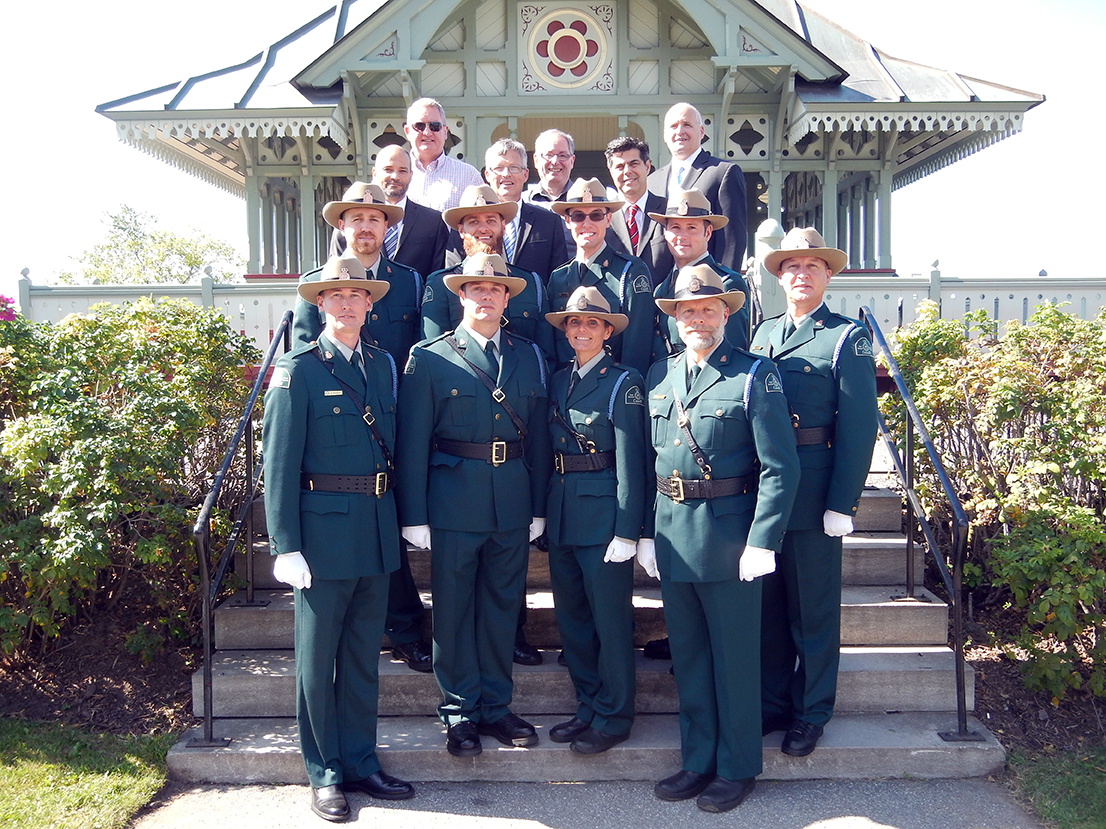
Last Sunday, hundreds gathered on Parliament Hill to pay their respect to the men and women of law enforcement who lost their lives during the course of duty.

This year’s ceremony was an occasion to remember the three Mounties who were killed during the June 4 mass shooting in Moncton. The names of a Toronto police constable and a Saskatchewan conservation officer who died in the line of duty were also added to the honour roll this year.

But the memorial also serves as an opportunity to say thanks to the countless police and peace officers who regularly put their lives at risk in the name of public safety.

In our national parks, that responsibility falls on park wardens. During the course of their day, these men and women face dangers ranging from unruly campers to hungry grizzly bears. The most recent fatality involving a park warden happened in 2002, when Michael Wynn’s life was cut short due to an avalanche.

Wynn, aged 37, had worked for Parks Canada for 13 years.

“Our national parks are breathtaking places,” said Eddie Kennedy, national advisor for Parks Canada. “But they come with their share of hazards. Our visitors owe a great debt to the wardens who keep our parks safe.”

Kennedy was in Ottawa last Sunday to represent our union during the ceremony.

Each year, the Union of National Employees and the Parks Canada Enforcement Branch collaborate to send ten park wardens to represent their comrades during the memorial. This year, the participants were Ben Alderman, Lisa Babineau, Courtney Bearinger, Jonathan Jansen, Eric Jensen, Daniel Keenan-Pelletier, Patrick Latreille, Julia Montgomery and Tyler Tilson.

The Union of National Employees wishes to recognize all our brave park wardens for their important public service.

parks2014