Last Friday, water rights were top of the agenda at the human rights committee meeting. Creative juices were flowing as the members around the boardroom table offered their ideas for a campaign aimed at promoting awareness of water as a human right.
During our 2014 convention, delegates voted in favour of a resolution to “fund the continuation of the water rights campaign adopted at the 2013 human rights conference.”
And when it comes to water, there are a ton of worrisome issues; there are countless communities in our own country who don’t have access to clean water, water is increasingly being privatized, major cities are seeing boil advisories…. And that doesn’t even include issues in the developing world.
“There was a lot of interest and discussion around the table,” said Geoff Ryan, national vice-president for human rights. “People felt very passionate about the issue; it’s a topic that’s very important to us.”
And for some, the issue hit particularly close to home. Jacqueline Nanali, who is a regional human rights representative in Manitoba, shared her experience with the boil advisory that affected all of Winnipeg, late last January.
“Everyone was running to the stores to pick up bottled water,” said Nanali. “Some chiefs, from nearby First Nations communities came back and said ‘well, this is what happens in our communities; this is how we live.’”
“I think it’s important for us to realize just how important water is. For me, losing basic access to water and having to boil water all day just for a simple glass of water to drink or a cup of tea… or just to brush my teeth; it really opened my eyes.”
The city of Winnipeg issued the boil advisory January 27 when the presence of E. coli was detected in the water supply; it was lifted 48 hours later. For two days, Winnipeggers were forced to boil water each time they needed to drink, cook meals, or make infant formula.
This incident garnered national attention from the media, but there are over a thousand boil advisories across Canada at this very moment. For many communities, what Winnipeg experienced is a daily reality.
After some fruitful discussions, the human rights committee members agreed that more light needs to be shed on how political decisions impact accessible clean water for Canadian communities. They dedicated a great portion of the day towards fleshing out a campaign.
“We’re very much in the beginning stages, but I’m excited to see what this will look like,” said Ryan. “We’re hoping to reach a broad swath of the Canadian public; I think many of the great ideas I heard around the table will help us accomplish just that.”
In 1966, the United Nations designated March 21 as the International Day for the Elimination of Racial Discrimination. It was meant to commemorate the 1960 massacre that took place in Sharpeville, South Africa, where a demonstration that started off as peaceful, ended with shots fired by police. That day, 69 South Africans were killed and over 180 were injured. The demonstrators took to the street to protest; they called on the apartheid government to abolish laws that required all black men and women to carry reference books containing their personal information. If someone was found without their book in a public place, they would be arrested and detained in prison.
Canada was among the first countries to support the UN resolution designating March 21 as the International Day for the Elimination of Racial Discrimination. Our nation first observed the day in 1989.
However, 49 years later, there is still much work to be done to wipe out racism. Every day, people are subjected to racist comments and stereotypes in the media, schools, public spaces and workplaces.
Continually putting the spotlight on race, ethnic background and skin colour creates an atmosphere where racial discrimination can thrive. Whether intentional or not, actions towards people based on their race, ethnic backgrounds or skin colour can have a negative impact on the day-to-day lives of racialized members of society.
I am often asked:
“Where are you from?”
“What is your background?”
“Where did you learn English?”
I am often subjected to unsolicited comments such as:
“You don’t look Chinese.”
“You speak good English.”
I recognize that questions are often asked out of curiosity, but it’s the manner in which questions are asked that is key! If the questions are asked as a means to get to know me and are asked in a respectful way, then, in the spirit of open dialogue, they are welcomed. If questions or comments pander to racial stereotypes, then please do not ask them or state them.
I am ethnic Chinese, but I am not from China (yet I have been told to “go back to China!”). This is a common remark made to racially-visible persons.
I am a Canadian with three children, two of whom were born in Canada; imagine how you would feel if your children were told to go back to a country they were not born in! Would you feel that your children were welcome and respected in their birthplace?
We live in a country of great diversity – one where everyone should be treated equally and with respect. So why do some of us have to work so hard to get people to look beyond our ethnic backgrounds, our places of origin or our skin colour? Why can’t people look at our skill sets, our abilities, our education, our experiences, and, most importantly, at our worth as individuals, instead? It’s sad to see that racial discrimination still exists. The only thing that will make a difference is when each and every individual is treated with respect and dignity – when we are all accepted on the basis of our own unique merits. In order to actively eliminate racial discrimination, we have to continue to educate and speak up. And we must actively work on racism, both on a personal and institutional level, for our children and for future generations.
Jennifer Chieh Ho is the regional vice-president for the British Columbia and Yukon region. This article was written as part of our union’s member journalism program. If you’d like to find out more, click here – to pitch a story or for any questions, please send an email to communications@une-sen.org.
Each year, my grandmother spends the greater part of the winter in Florida. For a few years now, I’ve been driving her car there so that she has the ability to run errands once she’s there. The first time I did that long drive to the Sunshine State, I travelled with my brother.
We stopped pretty regularly, picking up snacks for the road. One stop I’ll never forget was in South Carolina. It was late at night and we needed to get fresh supplies for the road ahead. When we entered the corner store, my brother and I were speaking French while we discussed what we intended to purchase. Once we made our way to the cash register, the cashier greeted us with a “Bonjour” and asked us, in French, if we had found everything we had been looking for.
My brother and I were surprised to hear this person speaking French to us, with a strong accent; we replied in English, as a means of accommodation.
The cashier was quick to tell us, once again in French: “No, please speak to me in French. I never have the chance to practice this great language, so when I have the opportunity, I take advantage of it.”
We happily finished our conversation in French.
Once we arrived in Florida, my brother and I decided to recount our corner store adventure to our grandmother. We were soon even more enthralled to learn that my grandmother’s friend had recently made a presentation to a conference held by the Alliance Française de Sarasota.
I’m proud to know that my language is sprinkled around the world; in the most unexpected places.
There is even an organization that represents Francophones across the world: the International Organization of La Francophonie. Created in 1970, its mission is to “embody the active solidarity between its 80 member states and governments (57 members and 23 observers), which together represent over one-third of the United Nations’ member states and account for a population of over 890 million people, including 220 million French speakers.”
Its members share the use of the French language and the values of “La Francophonie”, which includes working in solidarity to promote the French language, as well as cultural and linguistic diversity, democracy, human rights and education.
But even if someone doesn’t identify as Francophone, this doesn’t mean they’re not genuinely interested in our language. And it’s up to us, as Francophones, to foster that interest.
So, if I may, in conclusion, propose some friendly advice to my fellow Francophones: when someone attempts to speak with you in French – even if they struggle – don’t switch to English. We too often do this to be helpful, but I believe this isn’t helpful at all. We should embrace their efforts and provide them with a unique opportunity to practice our cherished language.
Karl Lafrenière is the regional vice-president for the Outside Canada region and a member of our francophone committee. This article was written as part of our union’s member journalism program. If you’d like to find out more, click here – to pitch a story or for any questions, please send an email to communications@une-sen.org.
Our members at Statistical Survey Operations are still waiting on news of their new collective agreement. Unfortunately, we don’t have any news to share right now. We’re, quite simply, still waiting with you.
When we last reported on the arbitration process in January, we told you that a decision should be rendered within three to five weeks. Unfortunately, the arbitration board is taking more time than was originally expected.
Since we presented our submissions, we have had no control over the process. We appreciate that this is a lot for us to ask from members who have been waiting four years for a decision.
Members of SSO have done a lot of waiting throughout this bargaining process. It’s been a tough one; negotiations first reached impasse in 2012. After filing for arbitration, the process was greatly delayed by an employer that challenged our ability to negotiate some of our bargaining proposals before the arbitration board.
What’s next:
Once the decision of the arbitration board is issued, PSAC will inform members at SSO of the decision. We also know that this delay has led to speculation among some members. All we can tell you is that any rumours you may hear are completely unfounded because no report has been published. No one, including our own bargaining team, has been informed of any decisions rendered so far.
How to get the news immediately:
The minute the news is published on our website, we’ll disseminate it on Facebook and Twitter. If you’d prefer to be emailed the minute the news is released, we can commit to that too: just send an email to communications@une-sen.org and tell us that you’d like to be informed as soon as the news becomes available.
Once again, we can’t express how much we appreciate our members’ patience throughout this process. We know it’s been a long and arduous road; we look forward to seeing you at the finish line.
Here we are, in the midst of negotiations with an employer that is hell-bent on saving money on the backs of workers. The talks are moving slowly – and many members are curious about possible job action. We’ve all heard it: members who declare, “I can’t afford to go on strike.”
Currently, we’re a long way from strike action. Negotiations continue, albeit slowly. All parties are at the table. Before we are in a position to strike, there are several things that have to happen.
First of all, a legal strike cannot take place without an essential services agreement, which outlines all positions that are designated essential. Bill C-4 gives the government control over essential services (although this is likely unconstitutional) and Bill C-31 has revoked all existing essential service agreements. The government must revisit and identify amendments to essential service agreements before we will be anywhere near a strike position.
Second, a legal strike can only take place once members of the bargaining unit have voted to initiate strike action. A strike vote can only happen if the PSAC national president authorizes the vote. Based on the results of the vote, the PSAC national president then has the authority to call for strike action. Members only walk the picket line if they have democratically voted to go on strike, and the PSAC national president calls for a walk-out.
We’re far from that point for the time being. There won’t be a vote held unless negotiations reach an impasse.
Is it true that our members cannot afford to strike? During job action, our members will not be paid by the employer. We all have obligations such as mortgages, car payments, tuition fees for our children’s education, monthly bills (and more bills…, heat, hydro, internet, telephone, etc.). Many members will struggle with keeping up with payments if they lose a week or two of pay. Any longer, and most members will have challenges.
I’d suggest that, in fact, with the current negotiations, we can’t afford to not strike. We stand to lose a whole lot more than a couple of weeks of pay.
One of the “features” of the “short-term disability” (STD) plan that our employer wants to impose on public servants is a seven-day unpaid waiting period before anyone qualifies for benefits. Think about it…. If you are ill and you have used up your six days of sick leave, any further period of illness is unpaid for up to five working days, before you qualify for “STD”.
And often the devil is in the details. What if you fall ill again at a later date? Will you automatically qualify for “STD” or will you have another waiting period? Having had some experience with the insurance industry, I suspect the latter.
Just when you need a paycheque, you may not get one. To make matters worse, you’ll have to deal with a for-profit organization like SunLife trying to pay you the least benefit possible.
Can I afford to strike? Not really. However, given what our employer is offering, we stand to lose even more over time. We can’t afford not to strike.
No one wants to get stuck with an STD, especially from this employer.
Richard Ballance is the regional vice-president for Treasury Board members in the National Capital Region.This article was written as part of our union’s member journalismprogram. If you’d like to find out more, click here– to pitch a story or for any questions, please send an email to communications@une-sen.org.
As International Women’s Day approaches on March 8, I think about the achievements and reflect on some of the barriers that I experienced as a Canadian working woman.
After a recent visit with my 91 year-old mother, I thought about the differences in our experiences as women growing up, going to school, working and raising a family. I got an amazing education in a non-traditional field and a good unionized job that provided benefits, including leave provisions and job security. But childcare was a big challenge for both of us. My dad worked hard in a low-paying job and my mom simply couldn’t work until we were all in school.
So, we got by on a very meager budget.
As for me, I lost so much sleep worrying about finding quality, safe and affordable childcare for three kids, including twins at a time when my partner and I were struggling to meet our high-interest mortgage payments!
Since those frenzied, stressful and costly days, great improvements have been made in parental leave and other benefits. But there is still no national childcare system. Families continue to struggle with child care, all while almost 70% of mothers with kids under 5 are working. The current federal program, the Universal Child Care Benefit, just doesn’t cut it for most parents. Canada lags behind other countries as they continue to develop their early-childhood education and care systems.
That’s why Canada’s labour movement is calling on all of us to make childcare an election issue. Did you know that the last federal election debate on women’s issues was in 1984?!The NDP and the Green Party have agreed to participate in a debate on women’s issues, but the Liberal Party of Canada, the Conservative Party of Canada and the Bloc Québécois have not. Campaigns are underway including Vote Child Care 2015 and Up For Debate.
I am reaffirming my resolve to take action to move women’s issues and childcare forward, not backwards. Let’s all of us make this a reality and let’s hope that next year’s International Women’s Day will give us another reason to celebrate.
Sandy Bello is the regional representative for human rights in Ontario. This article was written as part of our union’s member journalism program. If you’d like to find out more, click here – to pitch a story or for any questions, please send an email to communications@une-sen.org.
“Sorry to interrupt. I just wanted to come and say hello, since I saw you were here.”
It was Geoff Ryan. He happened to notice that Rose Touhey, Karl Lafrenière and Kenton Little, of Local 70130, were all huddled in a small office. After some friendly chitchat, Ryan adds:
“I just wanted to also say that I gave a bargaining update at the executive meeting, yesterday. I think the words that I used were ‘Karl, your Local is doing a phenomenal job in supporting the bargaining team. We all see it and we all really appreciate it.’”
“We wish Locals across Canada were as active as yours.”
Ryan isn’t alone in his opinion. During Local 70130’s 2013 AGM, Regional Executive Vice-President Larry Rousseau also took some time to praise the Local. At the time, Rousseau said he often uses that Local as a model for others to emulate.
“I continue to use them as an example of what Locals should look like and how involved and committed they should be – in the workplace as well as outside the workplace,” said Rousseau, in a recent telephone interview.
Larry Rousseau posing with Local 70130
Rousseau admits that this Local faced an uphill battle from its creation. He recalled his first site visit, when Pɑssport Canada first moved its operations to the outskirts of Gatineau. “This is going to be a huge mess,” he thought.“It was a Local with some really big challenges. But against all expectations, things really started to change.”
Local 70130 was born in 2008, after it split off from another Local, which represented members at the then-named Department of Foreign Affairs and International Trade. Our union’s national executive had endorsed the creation of a Passport Local in the National Capital Region; a subsequent vote of the membership made the split official.
Local President Rose Touhey explained that, before the split, there was little union presence on the passport side.
“At the time, the local president was doing it all by herself. You can imagine, for 2,500 people, how much work she had,” she said.
Touhey had been involved with her union in her previous job. It was when she saw a manager yell at one of her co-workers in her new workplace that she first noticed the need for a strong union presence.
Over the next few years, she would go from doing “all kinds of jobs in the union” to becoming local president.
With the help of others, she pretty much had to build a Local from scratch; there were a lot of issues to resolve. Plus, they had to deal with an employer who wasn’t used to having union presence in the workplace.
“We did have to struggle a bit to get going. At first, management wasn’t very receptive to us,” said Touhey.
“We filed a lot of grievances… a lot.”
It was around that time that a local team started to solidify. Isabelle Beaudoin, currently one of the Local’s vice-presidents, had just put her name forward, offering to help the Local. Eager to learn the ropes, she enrolled in quite a few courses, including the PSAC’s Union Development Program.
It was 2008; Beaudoin’s regional vice-president, Louise Patrice, was seeing great potential in this rookie union volunteer. Before Beaudoin left for the Union Development Program, Patrice told her, “you’ll see; you’re going to become a great union leader.”
“It’s true; I told her it would change her life,” said Patrice, who added that she was immediately struck by the eager youth members at Local 70130.
Recalling the first time she met Isabelle Beaudoin and Karl Lafrenière, Patrice said she saw stars in their eyes.
“I spotted them right away. I said: ‘we need to invest in those two youths. They’re incredible.’”
According to Patrice, the students soon surpassed their teacher. Her newest recruits were hungry for more responsibilities – for more files to be delegated to them.
“I’m very proud of them. I consider myself their godmother.”
It was Patrice who pushed Karl Lafrenière to run for the position of assistant regional vice-president in 2009; two conventions later, he became vice-president of the region. But back in the late 2000s, Lafrenière was heavily involved at the local level – part of an industrious trio. Working together, Karl, Isabelle and Rose started to make some significant breakthroughs in the workplace.
“They were a young gang,” said Patrice. “The talent was there. They had the enthusiasm. All they needed was some recognition and encouragement.”
The proof was in the pudding.
It took a tremendous amount of work, but management eventually came to see the union differently. One section’s director asked the Local to come see her in order to find solutions informally, before taking the grievance route. That process proved so successful that other directors started adopting it.
Pɑssport Canada went on to present an award to that director, for ushering in a new era in labour relations. For her part, Touhey was also verbally recognized for her hard work by the CEO and her director.
Likewise, Touhey’s Local can’t say enough about her hard contributions, which built a path for management and the union to work cooperatively.
“It’s because of Rose and because of the Local,” declared Karl Lafrenière.
It’s not to say that there aren’t problems anymore; but this approach has dramatically improved things in the workplace. It’s also led to many members having a positive opinion of the union and wanting to get involved.
“Many Locals have a hard time recruiting people; we have always have had a lot of interest. We try to make sure that everyone can participate in their own way,” said Touhey.
She says she often get requests that range from just a ‘hey, I want to help’ to a ‘if you need somebody, let me know’.
“That’s how we usually get people: people approach us.”
That’s sort of what happened with Jay Lamothe, one of the Local executive’s ambitious youth members.
“I used to carpool with Isabelle Beaudoin; she’s my neighbour,” explained Lamothe. “She would talk to me about everything the union did – not just inside of work, but outside. It really got me interested.”
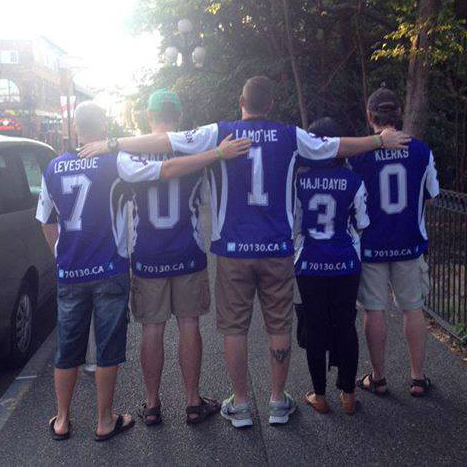
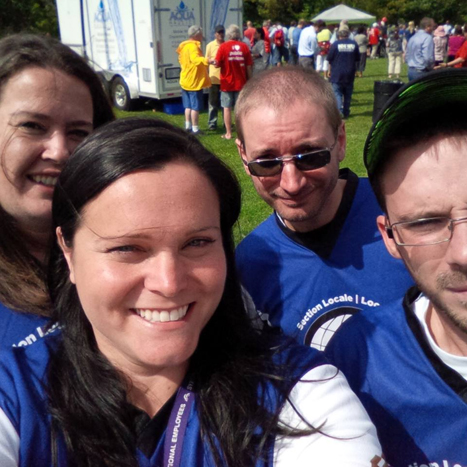
Members of Local 70130 sporting jerseys during UNE’s 2014 convention.Beauchamp DaBear
Beauchamp reading with Karl Lafrenière’s daughter (published with permission)
His first task was handing out PSAC bracelets. As his colleagues started to identify him more with the union, Lamothe got more involved. He’s currently one of the other local vice-presidents.Members of the local executive have also labeled him as their creative director. He’s designed stickers and posters. The Local also credits him with coming up with the idea for the team jerseys that made such a splash during the 2014 convention (though he humbly credits his fellow vice-president, Kenton Little, for “putting the wheels in motion for it to actually happen”).
“I’m a proud member of my Local,” declared Lamothe. “We’re such a strong team; what better way to identify ourselves than a jersey?”
“I really wanted us to stand out.”
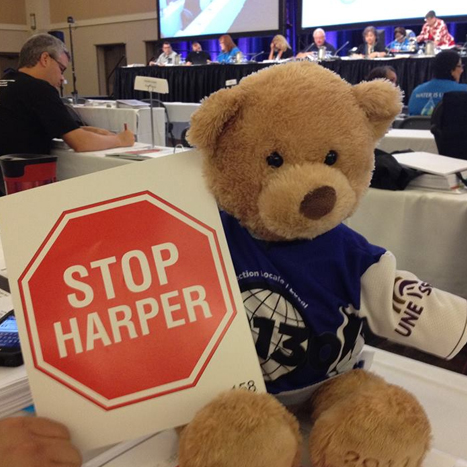
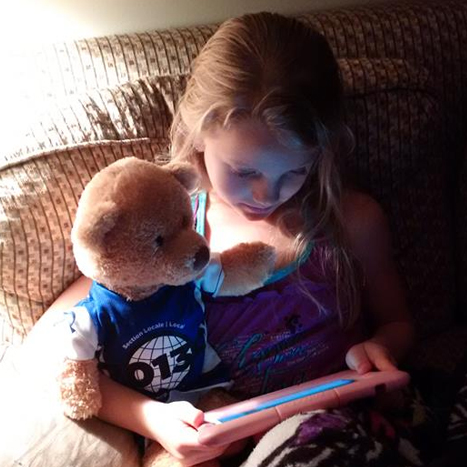
Unbeknownst to many, those jerseys were also the precursor to Beauchamp Dabear, the UNE’s littlest member. During convention, Dabear made appearances everywhere, sporting his Local 70130 jersey. He sort of became the unofficial convention mascot; he even had his own observer badge!
Given his charm and popularity, most people would never guess that Beauchamp materialized from a series of random events.
“The manufacturer printed us a proof – a mini-version of the jersey,” explained Kenton Little. The proof consisted of two crudely-cut individual panels: one for the front and one for the back.
“I thought that we should get it sewn together,” said Little. “My mom has a sewing machine and she could turn that into a t-shirt.”
“And it was free!” exclaimed Rose Touhey, with striking excitement.
And so, mom is recruited. A few days later, Little returns to find that mom has placed the t-shirt on a teddy bear. As for Beauchamp’s name? It’s simply the default name that the manufacturer uses when proofing jerseys (it’s always a good idea to use especially long names for proofing!).
Despite having his own Facebook group showcasing all of Beauchamp’s adventures (including trips to Florida and Cuba!), the stardom doesn’t seem to have gone to his little furry head. Recently, he even accompanied Karl Lafrenière’s eight-year-old daughter to school. Rumour has it he might also have a body-double.
“People have fun with Beauchamp,” mused Touhey. “Doug really likes him! He made Karl bring him to the national executive today.”
Indeed, Beauchamp was introduced as a special guest, that day, by the national president himself.
For Kenton Little, the man behind Beauchamp DaBear, getting involved in the union wasn’t something he had envisioned when he first joined Pɑssport Canada.
“I had never experienced a workplace with a union; I had no idea what that was all about,” said Little.
Then he got introduced to Rose Touhey and members of his Local; he decided to get more involved with the union. Eventually, he attended a regional seminar, where he developed a passion for grievance-handling.
“Kenton has a lot of initiative,” said Touhey. “What I love about Kenton is that I can say ‘here’s this, can you do it?’ and he always says ‘yes’. He’s not afraid to just go and do it. Kenton’s a self-driven go-getter.”
“Those are my nice words for the day,” she added, jokingly.
“Is this being recorded?” asked Little. (it was) “Can you send that to me? I want to put that on my union resume.”
Speaking of union resumes, Little had shown up to the interview with a document in hand: a long list of cool stuff that Local 70130 had done over the years. The kind of outside-the-box thinking that led to Beauchamp DaBear is evident in many of the Local’s other initiatives. For example, they designed stickers identifying the Local’s contact information; they affixed these to the very popular PSAC calendars to ensure that their members knew how to reach them. Membership cards are incorporated into every activity. A few years ago, they invited everyone for cake and held a draw for an iPad. To be included in the draw, members had to sign a union card.
“At that time, we already had a low Rand number. But after that draw, we must have signed up another 50 Rands,” explained Touhey.
A quick scan of the latest Rand report shows that Local 70130 has an especially low Rand percentage; quite a feat for a Local that has close to 900 members!
During that same cake party, they also decided to promote their Facebook group. Not only did they create a flyer, but members found those flyers stapled to every paper plate!
“You don’t have a choice; you’re going to see it whether you like it or not,” quipped Touhey.
And the local president isn’t shy about sending her members out for photo ops either, especially when the media is around.
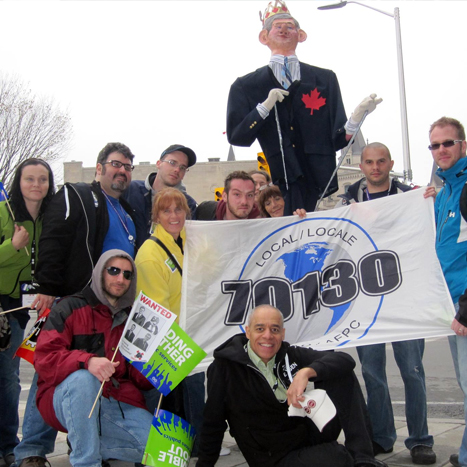
“It’s become a bit of a joke; we give the flag to Darrell Klerks (the local treasurer) and say ‘go get yourself on camera.’ Once, Larry was on camera; we sent a bunch of members with the flag to stand behind him.”
“We try to have fun and make it silly,” added Touhey. “But it’s good, right? Because, then we promote it to our members; it goes on the Facebook group and people see that we’re doing things and are active.”
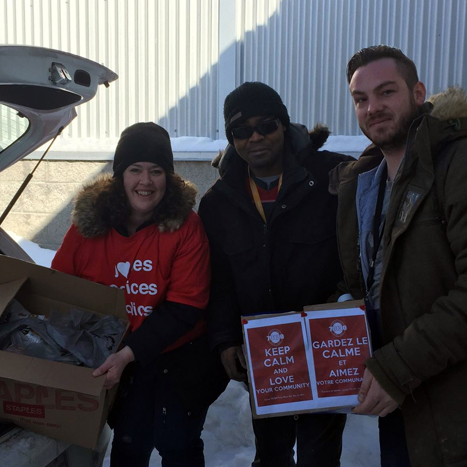
And the Local’s activism extends far beyond the workplace. Recently, they participated in a food drive for the Ottawa and Gatineau food banks; they even designed a poster! A few weeks before that, they collected a ton of warm articles of clothing, as part of a mitten-drive organized by Marc Blanchard, a TC bargaining team member who was struck by the large number of homeless people in Ottawa.
Local 70130, helping the community
“Isabelle Beaudoin had this brilliant idea to go to second-hand stores,” explained Karl Lafrenière. “They went to one close to work; for $10 they got a huge bag. They bought everything.”“Diane McDougall went to her manager, and the manager helped,” added Touhey. “They went around the building and asked people to bring in stuff the next day. We ended up getting other stuff from members of the Facebook group.”
McDougall, the Local’s new human rights representative, is the woman behind the UNE’s popular Be Like Diane campaign – a campaign that asked our members to emulate Diane by interacting with our Facebook content. McDougall has been a very active member since 2013; it’s only recently that she decided to run for a Local executive position.
“I love that woman like crazy,” said Touhey. “She just gives me happy vibes whenever I think about her.”
Likewise, members of Local 70130 are crazy about their Local President. Late last January, they got together to really show her how much they really care.
“Rose is always the one thanking and congratulating people on Facebook,” explained Karl Lafrenière. “But at some point, I said to people, ‘you know what, guys? She’s thanking everybody. She likes everybody. She inspires everybody. But who is saying thanks to her?’”
“We should say a big thank-you to Rose. She’s working hard… she’s like the heart of the Local.”
As Lafrenière tells it, Touhey quickly moved up to the position local president as different people left. While some people join a local with the goal of eventually becoming president, Touhey got thrust into the position and never stopped working diligently on behalf of the membership.
He says he couldn’t imagine a better local president.
So the Local immediately started looking into getting her an award. While Kenton Little wasn’t around to hear it this time, he got more praise, this time from Karl Lafrenière, for being the go-to guy (“Kenton has connections here and there; he’s fast with those things” – yes, that’s recorded too!).
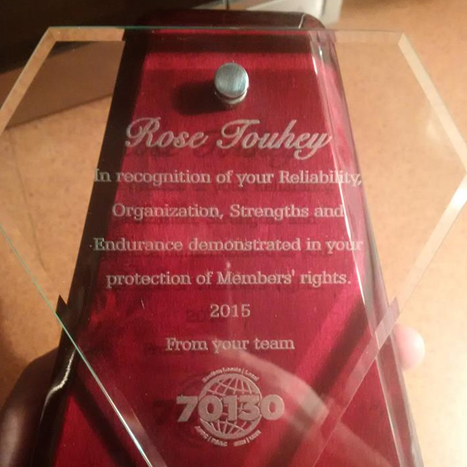
Rose’s award
For her part, Dianne Brown, the Local’s health and safety rep, wrote the message that was inscribed on the award.
In recognition of your Reliability, Organization, Strengths and Endurance demonstrated in your protection of members’ rights.
The capitalized qualities spell out Rose.
After luring Rose to one of her favourite restaurants, members of the Local presented her with the award. Lafrenière said she wasn’t expecting a surprise at all.
“She needed to be recognized.”
He says that his “freakin’ awesome” local president is constantly working on behalf of the membership. After putting in a long day at work, she goes home to update the Facebook group to keep the members informed. According to Lafrenière, Touhey considers it a duty.
“If you think about it, that’s probably why our Local is so recognized,” he explained. “She’s everywhere and she doesn’t stop. She makes sure that everything that needs to be seen is seen. It’s a lot of work.”
“If I sit down on the couch after I get home from work, I’m crashing! But it won’t be long before I hear my Blackberry going ‘PING! PING!’”
It’s usually Rose, asking for some translation help with the Facebook group. The Local is very focused on making sure its messages are equally accessible to its Anglophone and Francophone members.
One happy local president!
“We’re working together – we’re all putting in some degree of energy,” said Lafrenière. “But, I’m translating messages that she’s already spent quite a bit of time crafting. And she’s done that in between getting home, getting dinner started, getting her kids to Jiu-Jitsu…. She never stops.”In the middle of all of that, Lafrenière is receiving – PING! PING! – translation requests.
“Her determination is unbelievable.”
But even though it’s a lot of work, he says Touhey has a knack for engaging people and making the work fun. While there are so many members actively taking part in the Local’s vitality, he contends that Touhey is a powerful driving force behind the Local’s success.
“There aren’t enough words to say how awesome she is.”
We’ve taken the liberty of shamelessly stealing a few great pics from Local 70130’s Facebook page; you can catch these and others on our Flickr account. If you’d like to echo some of the kudos found in this article, we encourage you to leave a comment below!
Pink is a colour that has long provided a bright and easy target for bullies to attack. Unfortunately, it’s not the only subject of mockery. Even within the most progressive institutions fighting for equality and activism, bullying happens. People have always tried to bring themselves and their kin to equal footing with those of perceived privilege. Unfortunately, this is usually done at the expense of others; putting them down to bring themselves up.
I remember being at a union function, recently, where I heard a person of influence talk about our ability to lead change. They said that we need to bring people “out of the closet and into the light” to fight for our rights. Being a person who belongs to a group for whom “being in the closet” has a strong meaning, I took offence to this comment.
No matter what the closet is for you – be it sexual orientation, spiritual belief, political belief, union activism, etc. – why is it the goal of others to decide when you come out?
This is a form of bullying.
We need to remember that everyone has the right to be in the closet. Our goal ought to be to make society welcoming and respectful for those who are ready to come out.
Now that I have a son, I look at things differently. When it came to advancing civil liberties and human rights, I used to do things based on my own personal agenda. This year, I will be wearing pink on February 25 in the hopes that my son can grow up in a culture of equality – one where bullying is something he sees in old movies and in old stories, which lead him to wonder how we lived in such a barbaric time.
I hope that everyone out there will do what they can to stand up against bullying or, at the very least, reflect on how their actions and words can impact others.
Chris Little-Gagné, regional vice-president for Manitoba, and Jacqueline Nanali, regional representative for human rights for Manitoba, both wearing pink!
Christopher Little-Gagné is the regional vice-president for Manitoba and proud papa of two-year-old Caleb. This article was written as part of our union’s member journalism program. If you’d like to find out more, click here – to pitch a story or for any questions, please send an email to communications@une-sen.org.
We often say that the work performed by unions goes beyond improving the lives of its members and forges a greater impact on society as a whole. If you’re looking for concrete proof of this, you needn’t look further than the PSAC’s Social Justice Fund.
The 2003 national convention of the PSAC offered delegates an amazing opportunity to connect with labour leaders from South America. Two years later, in a speech to UTE convention delegates, PSAC president Nycole Turmel said it “marked a new era in international solidarity within the PSAC.”
“Our Social Justice Fund has started this process,” said Turmel. “I think that it has the potential to become a significant part of what our union stands for and does. But our Social Justice Fund also works in Canada and with our members who are involved in organizations promoting social justice at the international level.”
This still holds true today. About half of the fund is directed at programs within Canada. Its mandate is to support initiatives in five priority areas:
Humanitarian assistance in Canada and around the world
Anti-poverty initiatives in Canada
International labour development
Worker education in Canada and around the world
Worker-to-worker exchanges
During her speech, Turmel said she was especially proud of the work the fund was doing to eliminate poverty in Canada.
“It’s a disgrace that in 2005, poverty is still very much a fact of life here in Canada – one of the richest countries in the world.”
Unfortunately, things haven’t gotten much better in the last ten years. The gap between the rich and poor is growing. Canada’s tax benefit system used to offset income inequality by more than 70%; these days, it’s less than 40%. Canada’s richest 20% own almost 70% of all Canadian wealth. All the while, nearly five million Canadians are grappling with poverty.
That’s why the Social Justice Fund is focused on building a poverty-reduction strategy.
“The Social Justice Fund enables trade unionists, community leaders, social justice groups and those affected by poverty to develop strategies together to eliminate poverty. As supporters of Canada Without Poverty and Dignity for All, we are helping to develop a national poverty reduction strategy giving low-income people greater dignity and control. The Social Justice Fund supports the New Brunswick Common Front for Social Change, Alternatives North, NWT and Mackillop Centre, PEI working to create solutions at the provincial and territorial levels.”
In most collective agreements, the Social Justice Fund calls on employers to contribute one cent per staff hour worked. There are currently 91 collective agreements that include contributions to the Social Justice Fund.
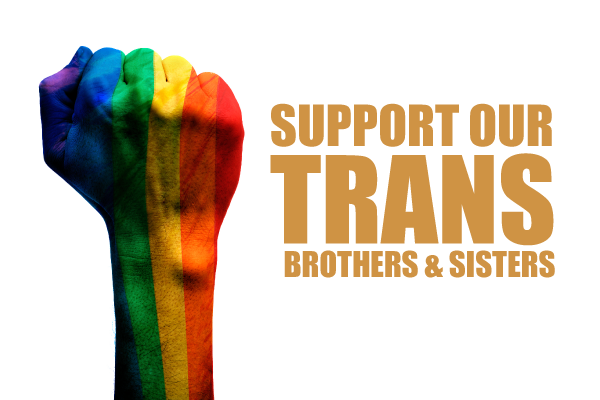
There’s a bill before the Senate that could once and for all protect transgender people from discrimination. Bill C-279 would finally insert gender identity into the Canadian Human Rights Act and into hate crimes legislation.
In the past, we’ve urged our members to contact their senators to express their support for this bill. We were ecstatic when, last year, Bill-279 passed the House of Commons with the support of 18 Conservative MPs.
Unfortunately, Conservative Senator Donald Neil Plett aims to bring toxic amendments to the bill; if passed, these amendments will likely lead to the bill dying on the order paper.
But it doesn’t have to be this way. You can take a stand for the trans community by contacting Senators on the Legal and Constitutional Affairs Committee. Tell them not to pass any amendments to Bill C-279 and to pass the bill in its current form.
My name is __________________ and I am calling from _____________________ to urge you to support the swift passage of Bill C-279 on Gender Identity as it is currently drafted.
Canada’s transgender communities have long suffered discrimination and violence and this legislation is part of the solution to protecting the human rights of transgender individuals.
I would like you to know that I am not afraid of sharing public spaces including bathrooms with transgender people.
But I am afraid that unless C-279 passes unamended, transgender people will continue to live in fear each and every time they enter a public space such as a bathroom.
Delays in passing legislation cost lives. This bill is as perfect as it’s going to get. Please do the right thing and support Bill C-279 as drafted. Let this be your legacy for this Parliamentary session.