Check Your Pay Stubs – Phoenix Pay System Coming Online

Phoenix

After years of development, the federal public service’s Phoenix pay system is now being rolled out for UNE members who are paid through Public Services and Procurement Canada (formerly known as Public Works and Government Services Canada). Like most major service upgrades, members should expect there to be some glitches along the way. However, this is not a small issue; this could directly affect the livelihood of families if problems with the system result in lower or missing financial income.

So what are members to do?

First, check pay stubs and direct deposits. If you notice any problems, there is a process to follow.

The government’s Pay Centre Escalation Process describes who workers should contact in cases where pay is inaccurate or untimely.

  1. Contact your manager to confirm your paperwork was sent to the Pay Centre. If it was not, acquire the paperwork to request a salary advance and follow up with your manager to send the paperwork. It is also important that you advise your human resources department right away.
  2. If the paperwork was sent, call the Pay Centre at 1-855-686-4729 to speak to a compensation advisor.
  3. If the compensation advisor doesn’t follow up within three days or you are unsatisfied with their response, contact the Client Satisfaction Bureau at pwgsc.clientsatisfactionbureau-bureausatisfactionclientele.tpsgc@tpsgc-pwgsc.gc.ca
  4. Please share your experiences with us. Did a problem with your pay occur? Did you resolve it yourself? Was the process an ordeal? Send us an email at info@une-sen.org so that we can work together with the employer and make certain our members are being paid.

There is a handy flow chart describing service standards and the problem-resolution process here: http://www.tpsgc-pwgsc.gc.ca/remuneration-compensation/paye-centre-pay/service-eng.html#a3

We anticipate each organization will have different approaches to solving issues with the Pay Centre. In addition to following the process provided, we highly encourage you to contact your human resources department.

As your union, we are here to help.


OLG Rideau-Carleton Raceway Slots Lockout Enters 3rd Month; workers vow to bring struggle to Queen’s Park

OLG3rdMonth

16 February 2016 — Workers at the Rideau-Carleton Raceway Slots in Ottawa are today entering the third month of being locked out from their workplace. The 124 workers were first locked out by the Ontario Lottery and Gaming Corporation (OLG) on December 16, 2015, after they overwhelmingly refused to accept a contract that would keep their wages frozen for two out of three years, and also force them to give up existing pension language from their current collective agreement.

To mark the beginning of the lockout, workers will be holding a barbecue in front of the Slots on  February 18 to celebrate their collective strength over the last two months.

  • BBQ will be held between 3pm and 5pm on Thursday February 18 at 4837 Albion Rd.
  • Workers and union representatives will be available for interviews.
  • Photo opportunities will be available.

“When OLG locked out these workers back in December, management thought they wouldn’t last more than a couple of weeks,” said Doug Marshall, President of the Union of National Employees, a component union of PSAC. “But the workers stood up for themselves and refused to be pushed around. They weathered the blistering cold and snow, maintained a strong picket line every day of the week, and met with provincial and municipal politicians to put pressure on OLG to end the lockout.”

The beginning of the third month of the lockout also coincides with the return of the Ontario Legislative Assembly from its winter adjournment, and locked-out workers are now determined to bring their situation to Queen’s Park and pressure the Liberal government to end the lockout fairly.

“We will make sure that Premier Kathleen Wynne and Finance Minister Charles Sousa hear from us,” said Larry Rousseau, Regional Executive Vice President of the National Capital Region for the PSAC. “And we will also let them know that our much larger unit at the OLG Woodbine Slots in Toronto will commence bargaining in the coming weeks, and they too will not accept attempts by OLG to take away pension language from their contract—we will stand united!”

Treasury Board bargaining: new government, old mandate

CBUpdate

Treasury Board bargaining teams met this week for the first time since the election of the new Liberal government.

We brought forward proposals addressing the needs that were identified by the membership and continue to work toward achieving a fair collective agreement.

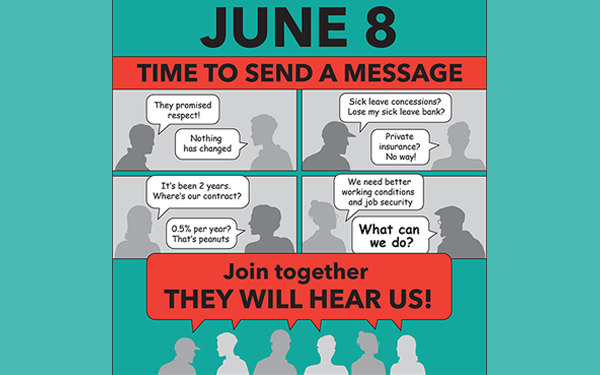
Given the Liberals’ election promises, we expected this government to bring forward a new bargaining mandate. In fact there was little indication of a change in approach.

We will not trade away sick leave

Treasury Board negotiators tabled a proposal similar to that of the previous Conservative government, that would replace our existing sick leave plan. It takes away existing rights and leaves members worse off. The proposed short term disability plan would fall outside of the collective agreement and allow the government to make unilateral changes any time.

We remain open to improvements on sick leave but we will not negotiate concessions or agree to any proposal that forces members to choose between losing pay or going to work sick.

Fair bargaining and Bill C4

We are pleased to see the government move to repeal Bill C59 (division 20), but there is still another unfair labour law on the books. The unconstitutional changes to labour laws governing the collective bargaining process under C4 remain a key issue.

It is a mystery why the government is not repealing this legislation in light of the clear pronouncements made by the Supreme Court in the Saskatchewan Federation of Labour case. We will continue to move forward with our litigation and take all necessary steps to ensure that there is free and fair collective bargaining for the federal public service.

At the bargaining table, PSAC will continue to focus on measures to improve the delivery and quality of public services and make the federal public service an efficient and healthy place to work. This benefits all Canadians.

  • EB: Our team focused on the issue of class sizes and making sure that our recommendations about the pay study are recognized and followed. For more info: psacunion.ca/eb.
  • FB: We put forward proposals to protect against the elimination of officer positions due to the introduction of technological change. The team also sought to protect compressed work weeks and prevent management from making unilateral changes to schedules. For more info: psacunion.ca/fb.
  • PA: We focused on working conditions in contact centres and the need to implement minimum standards in these workplaces. Our team also emphasized the importance of implementing shift scheduling by seniority. For more info: psacunion.ca/pa.
  • SV: Our ship’s crew subcommittee finalized the proposals that we will bring to the next round of bargaining. For more info:psacunion.ca/sv.
  • TC: Discussions focused on the need to better protect health and safety and to expand the definition of “family,” to remove discriminatory language. The team discussed hours of work, and the need to provide more allowances that recognize the unique and difficult nature of TC members’ work. For more info: psacunion.ca/tc.

Source: psacunion.com

OLG Refuses to Withdraw Ultimatum, Shows No Movement at Bargaining Table

OLGRefuses

Ottawa — Workers at the Rideau Carleton Raceway Slots (RCRS) in Ottawa met with Ontario Lottery and Gaming Corporation (OLG) management on Friday, January 29 for the first time since they were locked out on December 16, 2015. The workers, represented by the Public Service Alliance of Canada (PSAC), were hopeful that OLG would show some flexibility at the bargaining table. However, they were quickly disappointed to learn that OLG remains unwilling to change its last position, insisting that the union concede to its demands on wages and pensions—the two key issues in the dispute—before it will negotiate in any meaningful way:

  • Back in December, OLG insisted on freezing wages for the first two years of any new contract, and then providing a 1.75% increase for the third year. Workers had rejected this given that they had not received a raise since 2009, even though the cost of living in Ottawa has increased by about 9% in that period. Moreover, the locked out workers are currently paid around 8% less than workers doing comparable work at other sites, such as OLG Casino Brantford. At Friday’s meeting, however, OLG continued to insist that the total wage increase for the new three year contract will still be 1.75%.
  • Prior to the lockout, OLG insisted that workers agree to the removal of pension language from their current contracts. The workers had rejected this then, but on Friday, OLG continued to insist that workers agree to the complete removal of existing pension language.

“It is reprehensible that OLG would ask to meet with the workers again just to try to force the same substandard contract onto them once more,” said Doug Marshall, President of the Union of National Employees, a component union of the PSAC. “The workers already voted by 96% to reject OLG’s attempts to freeze their wages and remove pension language.”

“I want to be clear with Ontario Premier Kathleen Wynne: we will bring this battle to Queen’s Park if her government does not end this shameful attack on OLG workers here in Ottawa,” added Larry Rousseau, Regional Executive Vice President of the PSAC in the National Capital Region. “And we will not stop until her government treats these workers with the fairness and respect they deserve.”

OLG management at the RCRS locked out 124 of its workers on December 16. The workers served in a variety of roles, including as parking attendants, housekeepers, slot attendants, slot technicians, cashiers and money room clerks.


February is Black History Month – And Yes, it is still meaningful

BHM

By Hayley Millington

As recently as January 20th, 2016, during a conversation about the 2016 Oscars, U.S. actress Stacy Dash said on Fox News that she wants to eliminate Black History Month (BHM). According to Ms. Dash as she addressed the ongoing outrage over the lack of minority nominees in major categories;

“I think it’s ludicrous,” Dash, 49, said about the response to the lack of diversity surrounding the Oscar nominations. “We have to make up our minds. Either we want to have segregation or integration. If we don’t want segregation, then we need to get rid of channels like BET and the BET Awards and the [NAACP] Image Awards, where you’re only awarded if you’re black.”

Ms. Dash went a step further by saying “there shouldn’t be a Black History Month. We’re Americans, period.”

In 2005, Academy Award-winning actor Morgan Freeman said that having a Black History month was “ridiculous” and that the best way to end racism today is to “stop talking about it”. When questioned as to why, Mr. Freeman stated “You’re going to relegate my history to a month”.

The statements quoted here are a set of widely used, tried and tested propaganda used in America daily. The ideas themselves are used at any given time in discussions with other proponents who would like to remove Black History Month from the calendar with the premise that it hinders us (black folks) more than it helps us in achieving the American dream, not as a black person in America but as an American.

On this side of the border, attitudes towards BHM differ. All Canadians are invited to participate in BHM festivities as the legacy of black Canadians are remembered and celebrated. Canadians take the time to celebrate what Canadian people of colour have brought to the cultural mosaic that is Canada’s multicultural diversity.

It is important to recognize and not lose sight of the fact that Black History Month carries a significance that far outweighs the negativity as it allows people of colour to showcase their past and their present.

So while some to the south of us continue to devalue and misconstrue the importance of Black History Month, my point of view is that it certainly has a role to play in educating Canadians about its historical context and perspective.

For the next 29 days I am engaging my colleagues and friends with a BHM quiz that has been ongoing for the past 13 years in my place of work. When it opens up and creates a space for dialog about black history, the conversation becomes an opportunity to share my experiences openly and proudly with all who are interested.

Hayley Millington is the UNE’s National Equity Representative for Women.

Meeting of the National Executive

NatExecMtg

The National Executive of the Union of National Employees will be meeting from Tuesday, January 26 to Thursday, January 28, 2016 in Ottawa.

Should your Local have any item to be placed on the agenda for this meeting, please contact your Regional Vice-President and provide him or her with the necessary information in order that he or she will be in a position to place this matter before the Executive.

Rideau Carleton Raceway Slots Workers Facing Lockout During Holiday Season

RCSLockout

Workers at the OLG-Rideau Carleton Raceway Slots (RCRS) facility in Ottawa are facing a lockout as early as 12:01am on December 16.

The 124 affected workers, represented by the Public Service Alliance of Canada (PSAC), have been negotiating to reach a fair contract since May 2014 but have so far been unsuccessful. Key outstanding issues are reasonable wage increases and the future of the pension plan. Workers at the RCRS have not received a raise since 2008, and now earn significantly less than workers in comparable positions at other OLG facilities.

Workers will once again return to the bargaining table on December 14 in an attempt to reach a negotiated agreement that is fair and equitable.

On December 10, Slots management notified workers that if there was a labour dispute they would be denied access to health and dental benefits. PSAC has assured its members that should the RCRS not agree to the continuation of benefits, the union will provide health and dental coverage to all those involved in the labour disruption.

“We believe it’s only fair that after not receiving raises since 2008, the RCRS’s management should come to table with a reasonable offer that reflects the good work that our members do,” said Larry Rousseau, Regional Executive Vice-President for the Public Service Alliance of Canada.

“As we enter the busiest part of the holiday season, we really hope that this can be resolved at the bargaining table, without disruption to the RCRS’s operations, as we are sensitive to how many banquets and events have been booked at this location,” added Doug Marshall, President of the Union of National Employees, a component union of PSAC.

The 124 workers at the RCRS serve in a variety of roles, including as parking attendants, housekeepers, slot attendants, slot technicians, cashiers and money room clerks.

Register today for the NCR-SE Regional Seminar

RegionalSeminarNCRSE600x375

The NCR – Separate Employer regional seminar is fast approaching and it’s the best place to learn about our union and the many things we do.

Join us February 26-28, 2016 for an event jam-packed with lectures and workshops to help you gain the knowledge and confidence you’ll need to help our members. It’s also a great place to meet active members just like you and forge long-lasting friendships.

During the seminar, youth delegates will elect two of their peers to represent them as delegates to our 2017 convention.

You must register by Friday, January 22, 2016.


Visit the events page for more information and register today.

PSAC Takes Position with Labour Board

BargainingParliament

Union takes position that work of Constables and work of Scanner Operators are different, with specific bargaining issues.

The new employer for security services on Parliament Hill has made a proposal to the Public Service Labour Relations Board to merge both Constables bargaining units and the Scanners bargaining unit into one – meaning that there would be one contract for both Constables and Scanner Operators.

Constables and Scanners both play a role in ensuring the safety and security of the public, parliamentarians and their staff. But the work that each performs is substantially different, as are the issues and operational-settings, from scheduling to uniforms to firearms. As a union that represents thousands of law enforcement officers in the federal public service, PSAC has a great deal of first-hand knowledge about collective bargaining in a law-enforcement environment. In the case of PPS, the fact of the matter is that constables and scanners don’t do the same work.

As a result, PSAC is taking the position that Constables and Scanners should each have the ability to negotiate their own collective agreements. Regardless of the union that represents these groups, PSAC believes that the two groups should be separate in terms of their collective agreements. Just as the PSAC has taken the position that – despite the fact that both groups are represented by the PSAC – postal workers and editorial workers should each have their own collective agreements. The PSAC currently represents eight different, separate groups on Parliament Hill, each with its own collective agreement.

Also resolving this issue would ensure that PSAC can get back to the bargaining table in a more timely fashion and resolve issues related to the work of Scanner Operators.

We’ll be sure to update as things progress. If you have any questions or wish to see a copy of our proposals contact a member of our Bargaining Team.

December 6: National Day of Remembrance and Action on Violence Against Women

Dec6

Being tasked to write this article presented me with a challenge. I wasn’t sure of the best way to approach the topic of violence against women in order to deliver a piece that was insightful to the reader and meaningful to me. In my brainstorming sessions, I kept thinking of the 14 women who were killed on December 6th, 1989 simply for the fact that they were women. Images and thoughts from that horrific day resonated so strongly within me and kept repeating like a song on a continuous loop.

A chance conversation with one of my closest and dearest friends provided me with a “eureka” moment that gave me focus and reminded me of the enormity and severity of violence against women and how some of our sisters are continually living this reality – this perpetual motion. When you think about it, everyone knows someone or about someone who has been the victim of violence. As I sat there listening and bearing witness to the experience of a domestic abuse survivor, I was reminded about that continuous loop. And I was reminded that this wasn’t the first time I’d been privy to such tales of violence and triumph. The importance of being there to listen and lend support is integral to the victim’s support network.

(Thank you, Stacy, for bringing into focus the direction I needed as inspiration for this article.)

According to Status of Women in Canada, these are the facts:

FACT: Women are 11 times more likely than men to be victims of sexual offences
FACT: Women are 4 times more likely than men to experience intimate partner violence
FACT: Women with disabilities are at 4 times greater risk of experiencing sexual assault
FACT: The RCMP reports that nearly 1,200 Aboriginal women and girls have been murdered or gone missing in Canada
FACT: Young women between the ages of 15 and 24 experience the highest rates of violence
FACT: Since 1980, the number of non-Aboriginal female victims of homicide has been declining while the number of Aboriginal female victims has remained relatively constant
FACT: 8 out of 10 victims of intimate partner violence are women
FACT: Data suggests that one quarter of female students in college or university have experienced sexual assault or attempted sexual assault; 90% of these students knew their attacker
FACT: Women are 3 times more likely than men to experience criminal harassment
FACT: Aboriginal women are 3 times more likely to report experiencing violence than non-Aboriginal women
FACT: Aboriginal women are over-represented among Canada’s murdered women; they make up 4% of the female population but represent 16% of all murdered women
FACT: Sexual offences are 8 times more likely to be committed against girls ages 12-17 than male youth
FACT: 90% of Sexual assaults against women by a non-spousal accused are never reported to police
FACT: Women know their sexual attacker in three quarters of incidents

The facts here speak for themselves – women are targets simply because of their gender. So on this National Day of Remembrance and Action on Violence against Women in Canada I strongly urge you to acknowledge without pride or prejudice, as an individual and a society, that gender-based violence is not just a women’s issue, it’s an everybody issue. Ignoring and sweeping it under the carpet is no longer an option or an alternative.

Instead, we must address the issue; face the FACTs head-on.

Together, we can root out this malignancy that has us hobbled and look towards engendering a society where respect for women is the new norm rather than the exception. It is left to us to facilitate spaces where victims feel free to express their experiences and lend support where we must to enable the healing of all those who have been affected by gender-based acts of violence.
In closing, I would like to share this poem with you…

Victim

VICTIMS, each and every one of us
In one way or another – Victim
The unknowingly conscious recipient of some or other crime against
humanity – Victim

VICTIMS, each and every one of us
Properly thrashed and subjected, to some or another of society’s ills
Dissected and Rejected, ready to occupy another space on humanity’s
landfill – Victim

VICTIMS, each and every one of us
Pillaged and Plundered, left falling, failing, floundering for – just give me
just one more chance, come on give me just one more chance, ready for
another option outside of that of – Victim

VICTIMS, each and every one of us
Desperate for movement, anywhere else but between a rock and its hardest
place
Rendered incapable, unable to gasp for breath as life holds us each
immobilized, comatose and in a state of suspended animation – Victim

VICTIMS, each and every one of us

Hayley Millington is the UNE’s National Equity Representative for Women.