Human Rights Day: The Origin of Human Rights

December 9, 2021

I have often wondered about the origin of the Universal Declaration of Human Rights which was adopted by the General Assembly of the United Nations (UN) on December 10, 1948 in Paris, at the Palais de Chaillot, by resolution 217 (III) A. It specifies the fundamental rights of humankind. Because of the horrors of the Second World War, the international community decided to draw up an international bill of rights to affirm the values put forward in the fight against fascism and Nazism.

But as I continued my research, I found that the origins go back even further to Antiquity:

  • In the Nicomachean Ethics, Aristotle talks about the principle of dignity and the respect that the individual should have for others.
  • In Marcus Aurelius’ Thoughts and Cicero’s Tusculana (on the notion of jus hominum, “the right of men”), taking up Plato’s words.
  • In religious texts (such as the Ten Commandments, which command the right to life, to honor, etc.).
  • In Saint Paul, in the epistle to the Corinthians, who speaks about the interior man, totally virgin, by granting him an absolute dignity.
  • In literary texts, such as the play Antigone by Sophocles, or in philosophical texts, such as those of the Stoic school of thought.

Moreover, we find writings in several regions of the world like the Edict of Milan or Edict of Constantine I in the year 313; in the 13th century with the Charter of Manden in Africa; in the 15th and 16th centuries with the great Islamic jurisconsults of the Mali Empire.

Also, through the Great Texts (13th – 17th centuries), we can go back to the Middle Ages to find the first manifestations, concrete and with real effects in practice, of the idea of human rights, gathered under the name of human rights of the first generation:

  • The Magna Carta in 1215. This text is important but was only really used from the 17th century moving forward, as an instrument against the royal absolutism of the Stuarts.
  • The Twelve Articles in 1525.
  • The Petition of Rights in 1628.
  • The Habeas Corpus Act in 1679 (foundation of criminal law).
  • The Bill of Rights in 1689. It is considered in the English-speaking world to be the basis of current human rights concepts.

The first Declaration of Human Rights (June 12, 1776) was the one of the State of Virginia, written by George Mason, who was called “The Father of the Bill of Rights”. It was included in the Declaration of Independence of the United States on July 4, 1776, by Thomas Jefferson, and inspired the Declaration of Human Rights of 1948. A few years later, France, under the reign of Louis XVI, promulgated the Declaration of the Rights of Man and of the Citizen on November 3, 1789. Unfortunately, this declaration excluded women and it was not until 1948 and the intervention of Eleanor Roosevelt that the notion of gender was explicitly included in an international convention, the famous Universal Declaration of Human Rights of the UN.

Human rights are based on respect for the individual. Their fundamental principle is that a person is a moral and rational being who deserves to be treated with dignity. They are called human rights because they are universal. Human rights are the fundamental rights and freedoms that belong to every person in the world, from birth to death. These fundamental rights are based on common values such as dignity, fairness, equality, respect and independence.

In closing, I would like for this day to open up the discussion in your communities, your families, your workplaces because it is the basis for a better world and it is up to each of us to promote it by continuing to defend these rights. The UNE’s Human Rights Committee is proud of its leadership within PSAC and will continue to help members address the importance of respecting and defending those RIGHTS.

Daniel Toutant
National Vice-President for Human Rights
UNE-PSAC

Strike: Audit Services Group, Office of the Auditor General

November 29, 2021

PSAC-UNE members of the Audit Services Group, Office of the Auditor General (OAG) (Local 70153), began a job action against their employer on November 26, at midnight :

• 3 years without an economic increase of a patterned settlement with the core public administration
• 3 years without the employer willing to give them a designed pay grid, that has the look, feel and application of all other employees at the OAG, and practically every federal public servant
• 3 years of contract negotiations without an employer that has a mandate to bargain

A Public Interest Commission (PIC) report was received during the current contract impasse which was favourable to this workforce, 75% of whom are women. A request was made to move their dispute settlement route to binding arbitration. That was denied by their employer, knowing the PIC’s report would be a catalyst for the Audit Services Group to achieve a fair and just collective agreement.

Our request to meet with Karen Hogan, Auditor General of Canada, and Mona Fortier, President of the Treasury Board Secretariat, for the benefit of our members, was also unanswered.

OAG, get a mandate and return to the table.

UNE proudly represents our 160 PSAC members at the OAG.

Kevin King
UNE National President, PSAC

International Day for the Elimination of Violence against Women

November 25, 2021

As the International Day for the Elimination of Violence against Women approaches, I have a few thoughts that I would like to share with you. My first thought is WHY. Why is this still happening? Why as a society is this still okay? Why would anyone think this is okay? My next thought is, It’s NOT. It’s not Okay. It is not acceptable and it is not something that can continue.

As a society we should and do expect more. We need to protect our rights as Women, as Grandmothers, Mothers, Daughters, Sisters, Aunties, as Nieces. We need to make sure that everyone regardless of gender, sex, race, or beliefs are protected. This is not to be tolerated any longer. If you see something, say something. Take a stand, help out your fellow human. Be that person. We all have a right to feel safe and be part of society.

On this International Day of Violence against Women, stand with me and for all those beautiful women and say, No More. We will not sit by as women are being hurt, abused, and made to feel less than men. Sisters, Brothers, and Friends stand with me on this day in Solidarity and commit to ending the vicious cycle of violence against Women.

Let every Woman know We are Strong; WE are Resilient; We are Worthy; We are Beautiful, and we are Warriors. Reach out to the programs and the education that are in place to help stop this crime against Women. It is in our workplaces, in our homes, and in our communities. Let us all do our part to educate each other and use these resources to reach the Women who so desperately need them.

We are always stronger together and together is the way we move forward. We are the Spirit; We are the Light. We are the cycle of Life. We are bigger then and we will rise. We hope that on this day, you will all rise with us. Together as we educate, learn, pool our resources that are available to us, we will all become better Humans.

Yours in Solidarity,

Ellen Cross
UNE National Vice-President for Occupational Health and Safety

Common issues bargaining: Wages must keep up with soaring inflation

November 19, 2021

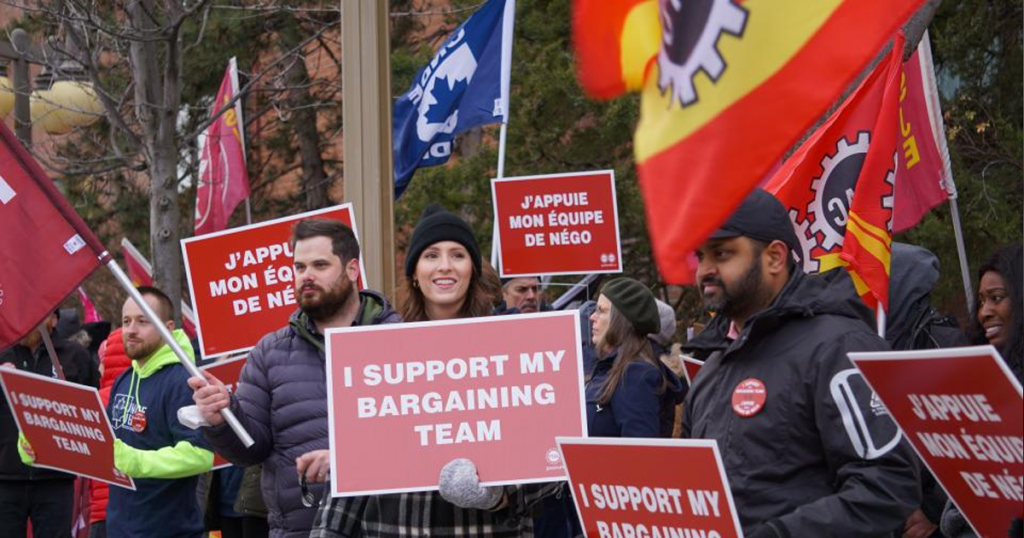
PSAC put forward a wage proposal for more than 110,000 federal public service workers that reflects skyrocketing inflation rates across Canada.

The common issues bargaining team proposed a 4.5 per cent wage increase in each year of a three-year agreement during negotiations with Treasury Board in early November.

Inflation rates are at the highest levels seen in more than 18 years, and members deserve a wage increase that keeps up with the rising costs of food, housing, and child care — anything less is a pay cut for federal public service workers. This year, the consumer price index rose 4.7 per cent on a year-over-year basis in October, up from a 4.4 per cent increase in September.

Many employers are recognizing there is a labour shortage and are increasing salaries accordingly to recruit and retain skilled staff. As Canada’s largest employer, Treasury Board needs to take on a leadership role by providing fair wages that recognize the rising cost of living and set the bar for other Canadian employers to help Canadians recover from the pandemic.

Group specific market adjustments, allowances, and grid re-structure proposals were not part of this package and will be submitted separately by the group-specific tables.

Employer refuses to discuss remote work

Treasury Board refused PSAC’s proposal to include remote work provisions in the collective agreement because they feel the inclusion of remote work is unnecessary and language on the right to disconnect is redundant.

Members have flagged work-life balance and the ability to work remotely as key priorities for this round of bargaining. Employees should have a say in when and where they work, and we will continue to push Treasury Board to negotiate terms for remote work and the right to disconnect into our collective agreements where they will be most effective.

New proposals on bilingualism bonus, anti-oppression training, parental leave

PSAC tabled new and revised provisions within the discrimination and sexual harassment articles to ensure our members have access to a fair process. The proposal expands the definition of what is considered harassment to better protect members. It also calls for mandatory training for all employees on the topics of “anti-oppression and discrimination,” and “harassment, sexual harassment, and violence in the workplace.”

Our proposed new training provisions push the employer to appropriately recognize and promote bilingualism in the federal public service, while the proposed increase to the bilingualism bonus aims to improve what is currently offered under the National Joint Council’s Bilingualism Bonus Directive, which has been stagnant for decades.

We also proposed improvements to maternity leave without pay and parental leave without pay to increase the top-up available to employees. We hope this will allow single parents and lowerincome families to better utilize the extended parental benefits option.

Upcoming bargaining dates

The bargaining team meets with the employer again on December 14 and 15, 2021.

The Common Issues table covers  members in the Programs and Administrative Services (PA)Technical Services (TC)Operational Services (SV) and Education and Library Science (EB) bargaining units.

Source: http://psacunion.ca/common-issues-bargaining-wages-must-keep-soaring?fbclid=IwAR1knoINxFbyrGvKt_soorYwEF-j6XJma1roiNcCGd2Aaq2ckWXeRI7JMVQ

Audit Services Group workers vote to strike after latest offer from management

The Audit Services Group has voted to give their bargaining team a strong strike mandate after talks collapsed at the bargaining table between PSAC and the Office of the Auditor General of Canada.

PSAC members at the Office of the Auditor General of Canada support the audit work the OAG conducts to ensure that Canada’s federal and territorial governments are accountable and productive. These members perform a wide range of technical, professional, administrative and clerical duties in support of the Office of the Auditor General. 

But members of Union of National Employees Local 70153 at OAG have been without a contract since September 2018.

Among the key outstanding issues are achieving a pay grid like almost every other group in the federal public sector, fair economic increases, and maintaining pay parity for certain classifications with non-union workers at OAG who received significant increases.

“PSAC members at the Office of the Auditor General have looked at the numbers and the employer’s latest offer doesn’t add up,” said Alex Silas, Regional Executive Vice-President of PSAC’s National Capital Region.

At the end of June, both the union and the employer presented their proposals before a Public Interest Commission hearing. The PIC report was released on August 25th and the Commission sided with the union’s proposals. 

“These workers just want fairness and to get what even the non-union workers at the OAG have received. The Public Interest Commission agrees with what we’re saying, but there’s been no movement from the employer on these key issues,” said Silas.

Despite the recommendations from the Public Interest Commission hearing, management at the OAG has not brought any significant changes to their offer, instead returning to the bargaining table with the same proposals.

“It’s time for OAG management to return to the table and respect the findings of the Public Interest Commission and respect these members and the important work they do,” said Kevin King, President of UNE.

“It’s not an easy thing to vote to strike and this is a first for these members at the Office of the Auditor General. I want to assure these members that PSAC has their back and will support their fight for a fair contract,” added Silas.

Changes to pay equity begin for federal public service workers

October 29, 2021

PSAC won a landmark pay equity victory for federal public service workers in 1999 that paved the way for more than 230,000 workers – mainly in women-dominated positions – to receive retroactive salary adjustments totaling over $3.6 billion. Members also secured ongoing pay adjustments to provide equal pay for work of equal value.

Despite this historic victory, women today still do not receive equal pay for work of equal value. The new federal Pay Equity Act is meant to address this ongoing inequity, and union members play a vital role in this process.

Pay Equity Act implementation begins

The Act was put into force August 31, 2021. This significant piece of legislation requires all federally regulated employers to implement pay equity plans within three years.

You may have already received a notice from your employer. By November 1, 2021, all employers are required to inform employees about the pay equity review process.

Read our FAQ about the Pay Equity Act

What are the next steps?

In order to develop and implement pay equity plans, many federally regulated employers will be required to establish joint employee-employer committees.

In unionized workplaces, union representatives will sit on these joint committees, adding a strong voice for workers at the table.

Joint committee members will develop a pay equity plan to determine if there are any compensation increases needed to ensure that employees are receiving equal pay for work of equal value.

This may be a lengthy and complex process for some joint committees that will require strong union representation and member participation.

How can I join a joint committee in my workplace?

For members employed by Treasury Board, the CRA or federal Agencies, your union Local will be working closely with your respective Component on these joint committees.

For Directly Chartered Locals, members will likely play a more direct role on joint committees.

To learn more about joint pay equity committees in your workplace, or if you want to get involved, please contact your union local. You can also contact PSAC’s pay equity team with any questions.

Potential employee compensation increases

Once the joint committee agrees on a draft pay equity plan, the committee is required to share the draft plan with all employees in the workplace for input.

When the final pay equity plan is adopted, employers must address any wage gaps by increasing the compensation of employees who are not receiving equal pay for work of equal value.

Where can I learn more?

Check out our resources on pay equity, including our frequently asked questions and our glossary of terms, to assist you with this joint committee work. We will be updating this page regularly.

You can also reach out to PSAC’s pay equity team with any specific questions you have about the pay equity legislation, how to join your workplace’s joint pay equity committee and the work of the joint committees at any time.

Source: Changes to pay equity begin for federal public service workers | Public Service Alliance of Canada (psacunion.ca)

PSAC welcomes new cabinet ministers 

October 28, 2021

Prime Minister Trudeau has named his new cabinet, responsible for carrying out the new government’s election promises. Their decisions will impact all PSAC members, particularly those employed in the federal public service.  

PSAC welcomes the new and returning ministers, including the new President of the Treasury Board, Minister Mona Fortier, new Minister for Public Service and Procurement, Minister Filomena Tassi, and the new Minister of Labour, Minister Seamus O’Regan Jr.   

“We expect Minister Fortier and Treasury Board to come to the bargaining table ready to address the issues that matter most to federal public service workers, including remote work, systemic racism, contracting out, job security, work-life balance and fair wages,” said PSAC National President Chris Aylward.   

“We also urge Minister of Defence Anita Anand to prioritize creating safe, inclusive, and respectful workplaces free of harassment for all employees in the Department of National Defence. Steps must be taken immediately to improve DND’s toxic culture and its impact on employees. 

PSAC will be watching for progress on key election issues including child care, post-secondary education, gender equity, systemic racism and reconciliation, an end to private long-term care and concrete action on climate change. 

“Canadians have put their trust in Prime Minister Trudeau to lead the country through a just pandemic recovery,” said Aylward. “We will continue to hold this government accountable and make sure nobody is left behind.” 

Source: PSAC welcomes new cabinet ministers  | Public Service Alliance of Canada (psacunion.ca)

PSAC opposes new Phoenix overpayment recovery plan

October 20, 2021

Last week, Treasury Board announced they would begin a new Phoenix overpayment recovery process for a number of PSAC members they believe were overpaid by the Phoenix pay system in 2016 and 2017.

PSAC has serious concerns with the new recovery plan because it significantly changes the way that PSAC and other bargaining agents negotiated how overpayments would be recovered. Typically, an employee’s whole pay file needs to be reconciled before any recovery takes place to ensure the amount owed is correct.

Affected employees may receive a letter from the Pay Centre asking them to acknowledge in writing that they were overpaid by Phoenix and to select an option for repayment. Employees will be given four weeks to respond. Otherwise, the Pay Centre will begin the overpayment recovery immediately.

National President Chris Aylward has repeatedly intervened to put a halt to this recovery process, and we are looking into our legal options to contest it.

Although we believe that employees who know they have been overpaid should acknowledge their debt and pay it back with a repayment plan that works for them, tens of thousands of PSAC members have been paid inaccurately by Phoenix and may not know if they were overpaid or underpaid nearly six years ago. Employees should not be compelled to acknowledge an overpayment – especially one they may not have the information to confirm is actually owed – under threat of immediate recovery if they don’t respond.

PSAC has repeatedly urged the government to hire and train enough workers to fix Phoenix errors as quickly as they can and to deal with older errors first. There should no longer be any unaddressed pay errors from 2016-2017.

In the meantime, if you receive a letter asking you to acknowledge and overpayment the union recommends that:

  1. If you are convinced you owe the overpayment amount stated in the letter, you can acknowledge that you owe the government the debt, and choose one of the repayment options that are provided to you in your letter, or request alternate arrangements if the payment options will result in financial or other hardship. We note that, in acknowledging that you owe this amount, you will likely waive any defence that may be available if the government exceeds the six year deadline for starting recovery of this amount.
  2. If you are not certain you owe the government the amount set out in the letter, respond to PSPC within 4 weeks and write:

“I have not been provided with enough evidence to convince me that I owe this money to the government because of an overpayment in (date).”

  1. If you continue to experienced errors in your pay in either of the above circumstances, you should also write:

“I continue to experience errors in my pay. I request that the recovery of any overpayment be deferred until such time that my pay file has been reconciled and I have received the correct pay for three consecutive pay periods.”

  1. Regardless of which of the above three options you choose, add either of the following if they apply to you:

a. “I was previously assured that the payments I received were correct and relied on these assurances to my detriment. I should not have to repay these amounts.”

b. “I was previously unaware that I had received an overpayment and understood that my pay was correct. I relied on that understanding and have suffered hardship as a result and should not have to repay these amounts.”

If you choose either of the second, third or fourth options, or if you have any other concerns not addressed above, or require any assistance with the above please contact us with your response by submitting a general inquiries form. Select Phoenix Pay Issues from the What is your inquiry about? drop down menu.

Source: PSAC opposes new Phoenix overpayment recovery plan | Public Service Alliance of Canada (psacunion.ca)

Your rights at work: Vaccinations and COVID-19 (UP-TO- DATE)

The federal government released its mandatory vaccination policy for federal public service workers on October 6, mandating vaccinations for all employees in federally regulated workplaces, including more than 160,000 PSAC members.

Read PSAC’s statement in response to the federal vaccination policy.

We have compiled frequently asked questions to provide PSAC members with as much information as possible on vaccinations in the workplace. This page will be regularly updated to reflect the changing circumstances.

Federal government releases vaccination policy without proper consultation

October 6, 2021

The federal government released its vaccination policy for federal public service workers October 6, mandating vaccinations for all employees in federally regulated workplaces, including more than 160,000 PSAC members.  

Treasury Board has encouraged Crown corporations, agencies, and the Canadian Forces to implement similar policies, but this policy will not immediately apply to them.

Read the full vaccination policy 

PSAC fully supports a federal vaccination policy to protect the health and safety of our members and the Canadians they serve. We know that increasing vaccination rates is the best and most reliable way to slow the spread of COVID-19 in our workplaces and our communities and encourage our members to be vaccinated.  

However, if the goal is to keep the workplace healthy and safe, this policy still falls short.  

The government rushed their vaccination policy without meaningful consultation with the unions representing federal public service workers. Treasury Board gave unions less than a single business day to provide feedback on their policy, and then failed to incorporate any of the changes into their final policy. Our union supports the government’s vaccination framework, but how it is applied matters, and we expect the employer’s implementation of the policy will respect:  

  • Members’ privacy rights: Any personal information collected must be shared on a need-to-know basis only and collected and stored for a limited period and in keeping with the Privacy Act.  
     
  • Bargaining rights: Bargaining agents should be included in meaningful consultation as these frameworks and policies evolve, including adequate time to provide feedback and input.  
     
  • Human rights: Members’ human rights must be protected under the Canadian Human Rights Act, including the duty to accommodate. 
     
  • Health and safety: Workplace health and safety committees must be consulted about the implementation of the policy. 
     
  • Equity and inclusion: The policy must consider the adverse impacts of the policy on historically disadvantaged groups of employees, including racialized, Black and Indigenous employees.  
     
  • Consistency: The government’s vaccination policy should also apply to federal contractors and the general public who interact with federal public service workers to ensure the health and safety of our members. The vaccination policy also needs to be applied consistently across federal departments and agencies.  
     
  • Fairness: Employees who are required to be vaccinated or who experience side effects should not have to use their own sick leave banks, and this should not be left up to the discretion of individual managers. 

While the vast majority of PSAC’s membership is fully vaccinated, PSAC will continue to represent unvaccinated members who have punitive action taken against them as a result of their vaccination status.  

We’ll continue to work to ensure the implementation of the policy protects the health and safety and human rights of our members while ensuring their rights to privacy are respected. 

Keep your member info up to date to receive all the latest updates about the government’s vaccination policy, bargaining issues and more.  

Source: Federal government releases vaccination policy without proper consultation | Public Service Alliance of Canada (psacunion.ca)